Travel
Travels with My Ancestors #4: People of the West Country – the Newtons
This is the fourth in the ‘Travels with My Ancestors’ series. You may like to read the first in the series to provide context – you can find it here.

Beautiful Bath Abbey My little travel party drive out of Bath, Somerset’s – and arguably England’s – most beautiful city. The gracious buildings of smooth Bath stone carry echoes of Georgian prosperity and indulgence, while the Roman baths and statues and the soaring Abbey remind us that people have worshipped and socialised here for more than a millennia.
Now we venture into the unknown – rural Somerset. My father’s forebears hailed from a cluster of small villages that circle the Quantock Hills in the northwest of the county. As we leave the busyness of Bath behind us, the landscape changes almost immediately, from crowded streets and town houses to lush, green farmland blanketing gentle slopes. Black faced sheep and spring lambs are dotted across the fields, their woolly bodies a contrast beside the vivid yellow of canola crops.
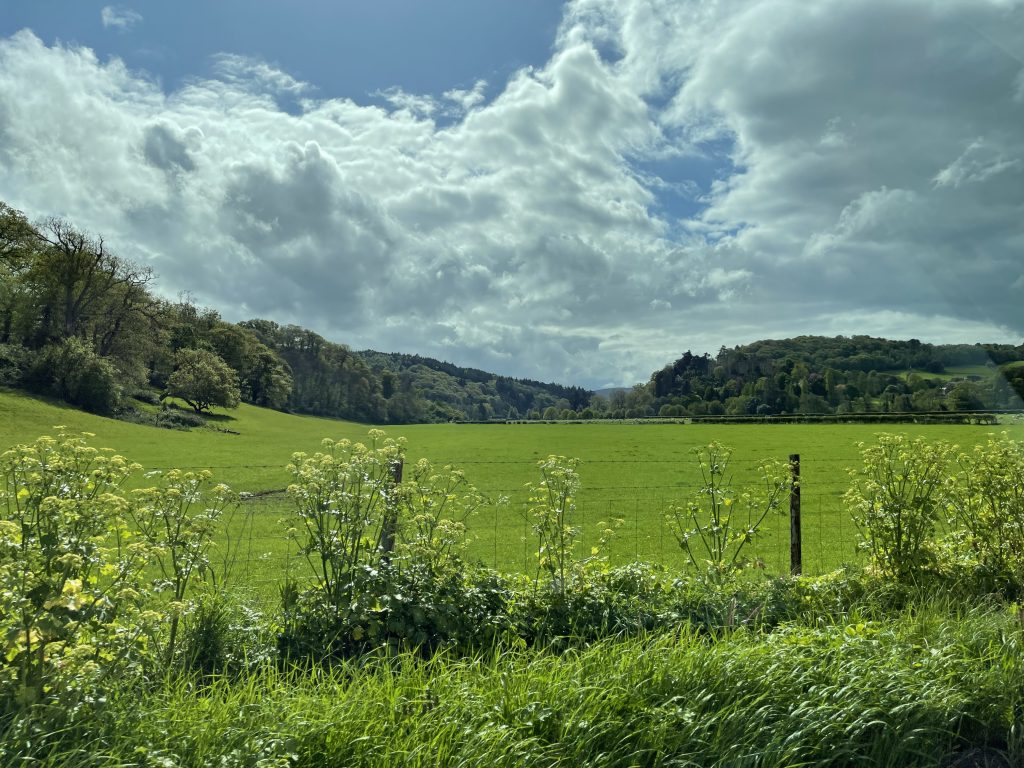

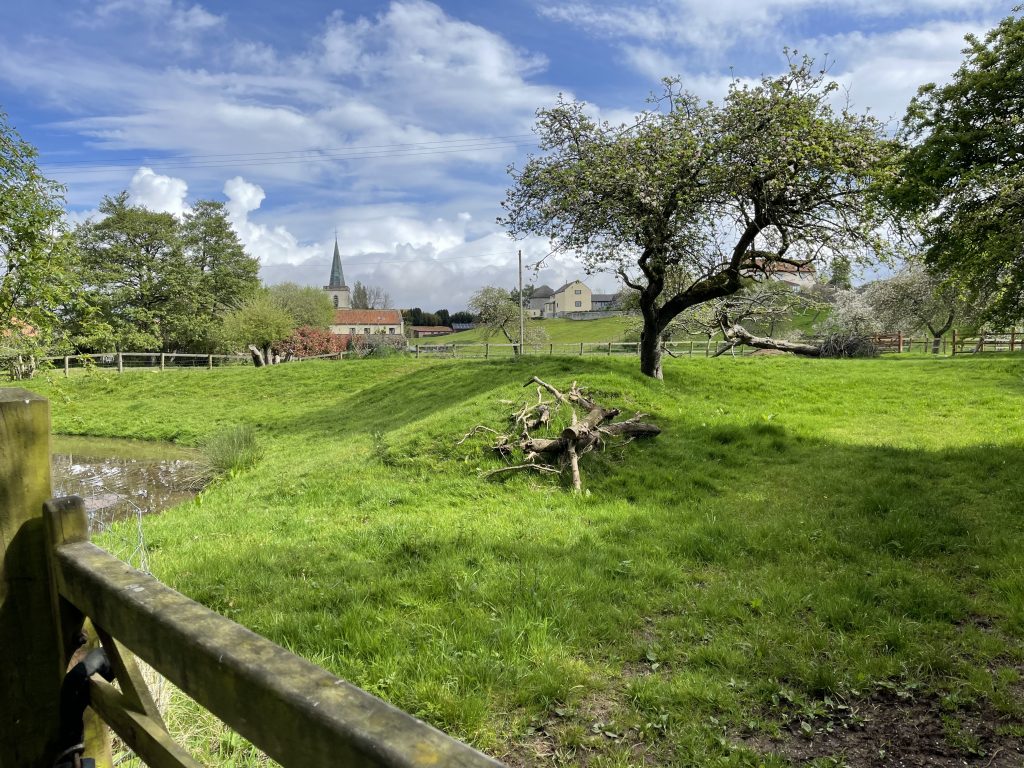
The Somerset Newtons were not people of means. Most worked as labourers on the many farms of the district, though there were occasional tradesmen such as butcher or carpenter, skilled trades in demand everywhere. Farms and farming have changed and grown since the seventeenth and eighteenth centuries, but the soil the Newton men and women tilled and the animals they tended, are much the same today.
The villages connected with the Newtons and the families they married into have almost unbearably quaint names: Crowcombe, Combe Florey, Nether Stowey, Bradford on Tone, Dunster. From Australia I have been searching out these names on Google Maps, drilling down to Street view on Google Earth to glimpse the places the Newtons called home. I was delighted when thatched cottages, green fields and timbered woodlands appeared on my screen: many of these places were still small rural settlements; the years had not transformed them or carved multi-lane highways through their hearts.
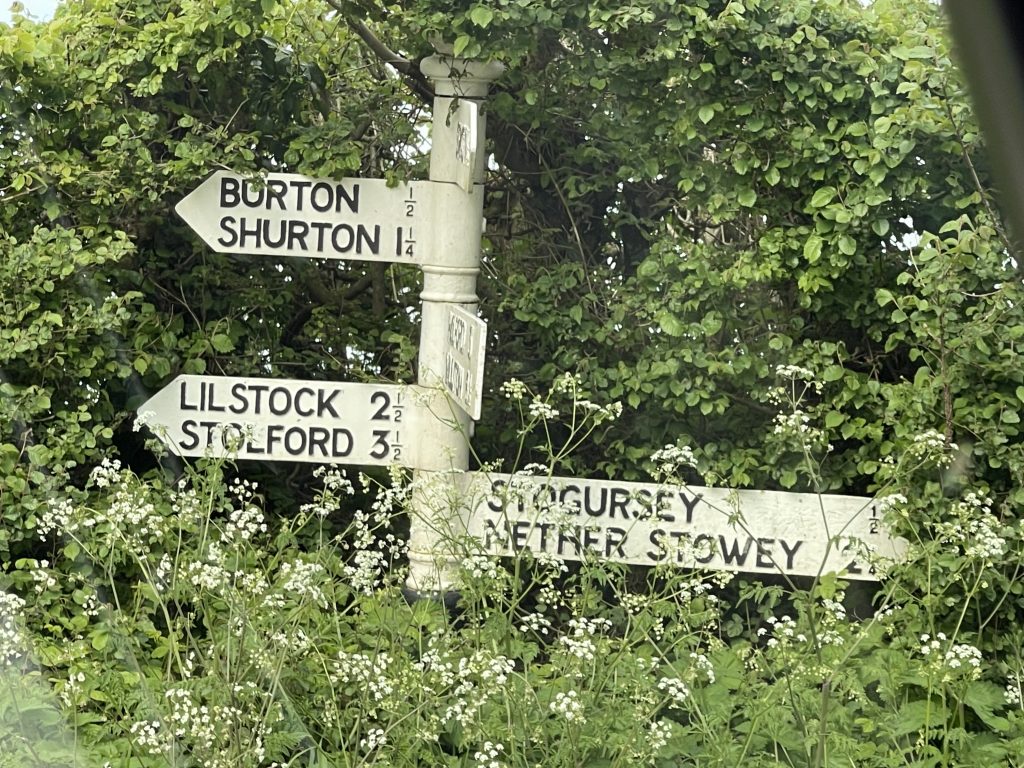

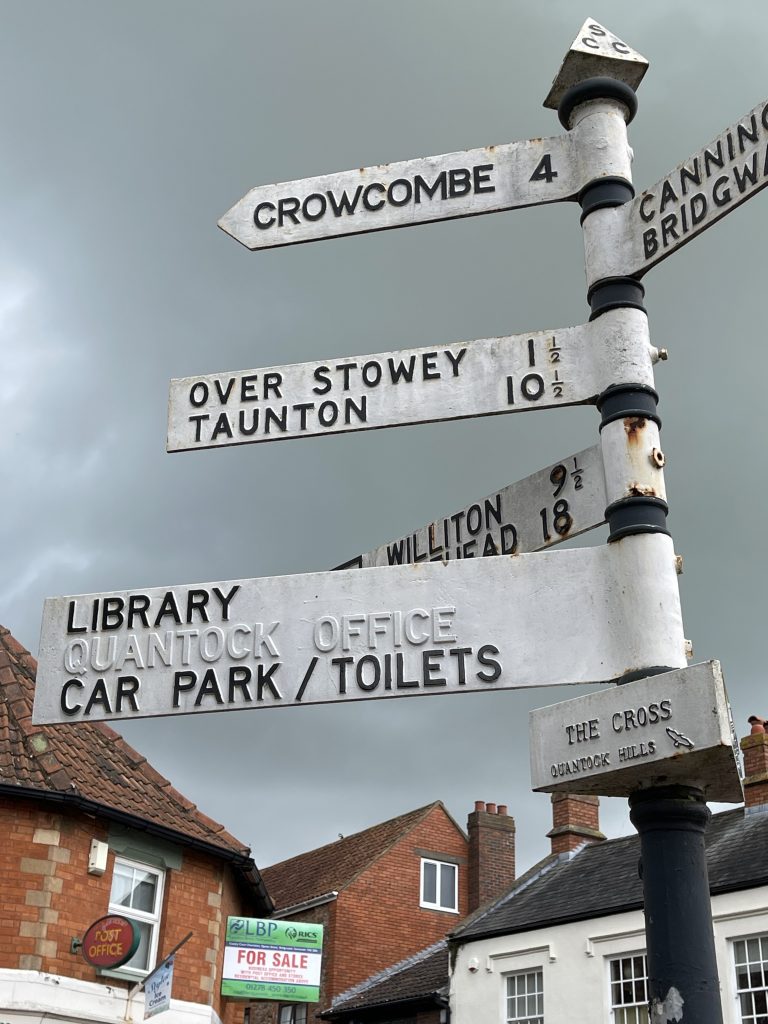
Now, I am here in person, for real, to see and smell and hear these places I’d been learning and writing and dreaming about for the past three years.
I am excited, of course. Mixed in with that is a hard to define emotion. A sense of arriving at a place that some part of me recognised. Despite all my research, Googling and map reading, I had not really known what to expect. A backwater, left forlorn as other parts of the county progressed into the modern age? Tattered villages populated by elderly folk suspicious of ‘outsiders’?
Instead, what I find are stunning landscapes and well-preserved towns and hamlets. The pleasure and relief I feel is almost overwhelming, and surprising. I feel connected with this country in a visceral, unexpected way.
This is the West Country, the land of origin of my father’s people, and I am loving what I see.
Village Life
Of all the villages, the one in which I will leave a little piece of my heart is Crowcombe. Here I visit the wonderfully named Church of the Holy Ghost, where I stand at the baptismal font where generations of Newton babies were welcomed into the community of the then Church of England, back to at least 1630.
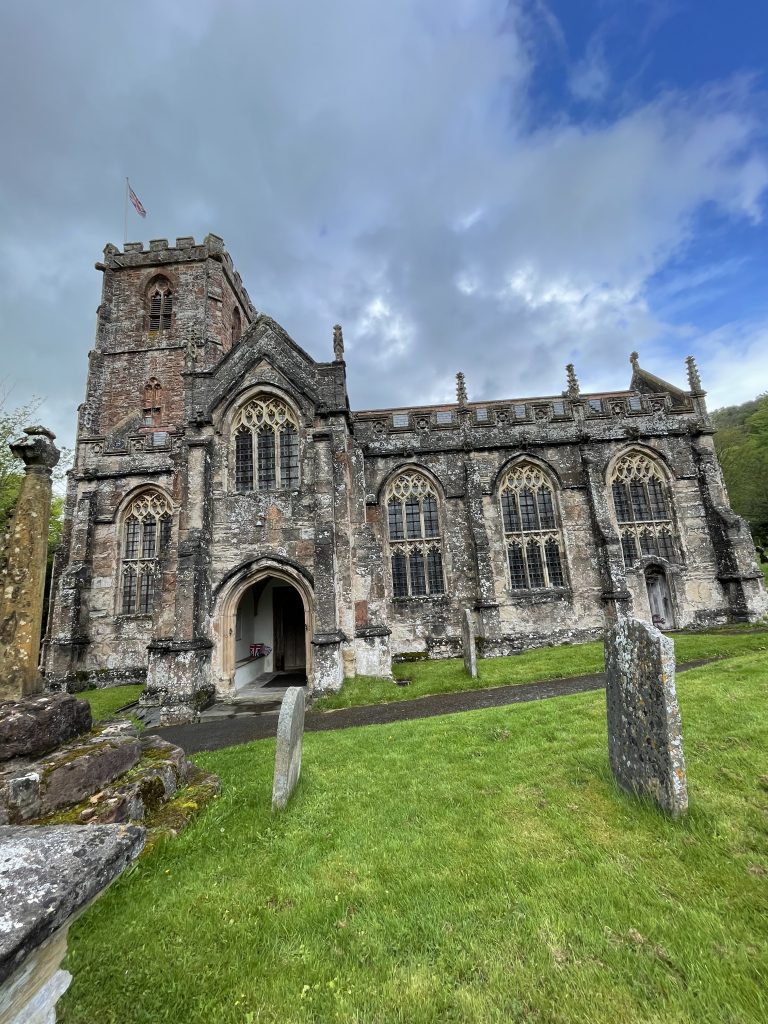

Like pretty much all of the village and parish churches I’ve gazed at on this visit, the Norman era tower is very tall and square. Sometimes they look more suited to top a castle than a place of worship. Inside, though, it’s a different story.
This particular church is famous for its mediaeval intricately carved bench ends: the wooden partitions at the end of each pew. They break the mould of church decorative art, depicting among the Christian symbols an array of folk tales and pagan imagery. The most imaginative ones, in my opinion, are those that tell of the battle between two men and a giant and fearsome ‘Gurt worm’, a kind of dragon, which they cleave in two. The divided creature went on to form two local hills. As I snap photos of these vivid carvings, I imagine young Newton children endeavouring to sit still during Sunday service, being transported out of the church into a world of legends from Somerset’s past.

Carved pew ends at Crowcombe church 
The Crowcombe pub, the Carew Arms, has been the village meeting and drinking place since the 1500’s, when it was known as the Lion, then the Three Lions. Many Newtons would have enjoyed an ale or a local Somerset cider there. Today the pub shows its venerable age: the flagged floor, low heavy beams along the ceiling, and the stables (the stalls now cleverly converted to booths.)

The Crew Arms pub in Crowcombe 
There remains a sense of community and connection in the village. The Carew family have lived in the manor house for centuries, and continue their time-honoured role of support for community projects and events. In the village I spot a lovely mural of tiles, a Covid lockdown initiative, in which residents were invited to decorate a tile. It now hangs proudly on the wall of the pub.

The Crowcombe Mural, a Covid community project 
It is Coronation weekend when we visit (the May 2023 Coronation of King Charles III) and Crowcombe, along with most of the villages and towns we pass through, is celebrating with a village BYO picnic in the field of one resident. I’m an avowed Republican but I am moved at the level of community connection this event has inspired.
Coincidence? Or a new family mystery to investigate
In Nether Stowey’s Church of St Mary, my husband spots a plaque on the wall commemorating three members of the Buller family. Husband Robert Beadon Buller and his wife Ann, both of whom died and were buried in the churchyard in 1841. Their son, also Robert Beadon Buller, was also remembered there after his death in 1880.

Martha Buller married a Newton man in that church in 1798. Were the Buller family members on the plaque related to Martha? Looking at the birth and death dates, it seems possible that Martha and the elder Robert were siblings, cousins, or some other close family relationship.
The intriguing thing is that ‘Beadon’, the Buller father and son’s middle name, is a name that appears several times in the Newton family tree. I have always assumed that it was a Newton family tradition – but is it possible it came from the Buller family, brought with Martha to the Newton line when she married? If Robert Beadon turns out to be her relative, that theory might well hold water.
That same day, a Crowcombe local suggests we look at a house in the village Main Street, which has ‘Beadon’ on a name plate on its front fence. Then I turn around and – directly opposite – there is a house with the name Newton Cottage on its gate. A coincidence? The tingle in my fingers and toes suggests not. I learn that Newton Cottage was built in the 1870’s – after my Newtons had emigrated to Australia – but surely the people who built and lived in that cottage were part of the larger Newton clan in and around the village. And surely, Beadon could be connected somehow.
For now, I don’t know, but it’s a theory I will be exploring once I am back home in Australia. The tingling fingers and toes can’t be wrong. Or perhaps I will uncover some other previously unknown connection or branch of the family tree.


As we leave Somerset, I feel an invisible skein unravelling behind me, connecting me to this West Country, the land from where the Australian Newtons came, one hundred and eighty years ago. I take with me that connection, surprising but so very welcome, and I hope I will return one day.
All photos by the author
For more stories from my Travels with My Ancestors, you can subscribe to my blog.Travels with my ancestors 3: Elizabeth Lee – Lancashire Lass
This is the third post in the Travels With My Ancestors series. If you’ve not read the first post to give context to the series, you can find it here.
*
On a July morning in 1791, a signal went up on the south head of Sydney harbour, indicating that a sail had been sighted. People ran down to watch as the Mary Ann berthed in Sydney Cove. The signal created great excitement because the new arrival promised more supplies to hold off food shortages in the faltering penal colony of New South Wales, Australia. Mary Ann was the first to arrive of the eleven ships of the Third Fleet that set sail from England for the colony. Along with provisions such as barrels of flour, beef, and pork, she carried convicts: 141 women and 6 children.
Elizabeth Lee was among those on board. Born and raised in Lancashire, she’d worked for a woman named Elizabeth Buckley in Manchester, either as a domestic servant or shop assistant.
In 1789 things went badly wrong for her when she stole a grey cloak valued at sixpence from her mistress. If she’d hoped to sell it for coin, luck was not with her. She was caught, and in January the following year, she pleaded guilty at the Manchester Epiphany Quarter sessions, at the Royal Cotton Exchange building at St Ann’s Square.
Her sentence was transportation for seven years to ‘some parts beyond the seas.’ What did that mean? Where would she be taken? At just seventeen, she was friendless, facing an uncertain and frightening future.
Elizabeth was my 4 x great-grandmother.
*
In April 2023 I set off on a family history tour of England, accompanied by my husband Andy and our friend Anita. Manchester was the first place to explore: where Elizabeth had lived, work, and where she committed her crime.
I found the location where once stood the first iteration of the Royal Cotton Exchange, a grand building where the serious business of buying and selling cotton was done in the eighteenth and nineteenth centuries. It also housed the court rooms where the equally serious business of dispensing British justice was conducted. Two years after Elizabeth’s trial, the original Cotton Exchange was demolished to make way for a new building. Today the building is the home of the Royal Exchange Theatre.

Royal Exchange Theatre, Manchester, April 2023. Photo by author. Gazing up at the imposing structure, it occurred to me that there was a relationship between the two purposes of the original Cotton Exchange. One was for wealthy merchants and traders to generate profit from the resources produced by the labour of enslaved people in the West Indies and America. The other was to punish those outside the system of capitalism that flourished alongside colonialism, the slave trade and the Industrial Revolution.
Poor people, young women such as Elizabeth, had no place in that system. They were despised, mistrusted by their social and economic ‘betters’, regarded as the criminal class by those in authority. Having stolen from her employer, she was in the court to have her position in the world firmly marked out for all to see.
I don’t know much about her family or her early life. If she had parents and siblings still alive, they would have been unable to see her again, because from Manchester she was taken north to Lancaster, where she spend a long year imprisoned in the Castle on the hill, overlooking the River Lune.
Approaching the forbidding dark walls of the Castle’s gate, she would have been gripped by a deep foreboding and a fear that she may never re-emerge from it.

Gateway to Lancaster Castle, May 2023. Photo by author The Castle operated as a prison until 2011. It is a melange of stone building styles from the eleventh and twelfth centuries to the Victorian era, during which parts were built, demolished, added or altered.
In Elizabeth’s time, the Castle prison was crowded, with poor hygiene and rations. Punishments for disobedience were harsh; sometimes involving pointless, soul-destroying labour such as the treadmill. The year she spent there dragged slowly, months feeling like decades.
At last, with February frosts nipping at fingers and toes, she was taken with other women from the Castle on a long journey south to London, to Gravesend on the Thames. Here she was rowed out to a sailing ship, the Mary Ann, where she had the first sight of the below-deck quarters where she would sleep, wash and eat, for however long it took to sail to that far-away place that would be her next prison.
When the Mary Ann shipped anchor, she thought this would be it: her last moments within sight of England. But no: they sailed out of the Thames, then south and west to Portsmouth, where the ships of the Third Fleet gathered in readiness.
The Mary Ann sailed from Portsmouth on 23 February 1791. Just two days out, Elizabeth and her companions experienced their first storm at sea. Women were washed out of their beds by the force of water that poured in between decks. Fully expecting to perish in the violence of the towering waves, frightened prisoners prayed amid the shrieks and wails of their companions. The howl of the gale outside echoed their despair. A full day and night later, the wind and rain eased and the voyage continued. [i]
Captained by Mark Munro, the ship battled through the difficulties of weather, long periods without supplies of fresh food, and all the other challenges of a lengthy voyage. She made good time, and when she berthed at Sydney Cove, only four of the convicts on board had died.
Several residents of Sydney Town, including Captain Watkin Tench of the marines, had rowed out excitedly to meet the ship before it entered the harbour. From their quarters, the convicts heard the shouts of the visitors climbing aboard the ship. Eager questioning turned to disappointment when they learned that not only had the vessel brought less food than hoped for and more mouths to feed, but that no one on board had thought to bring any mail, or newspapers, or a single magazine. [ii]
Most of the women waiting to see what this place would be like had little interest in newspapers. But they thought of the homes they had left, and the people and places they would never see again, and wept.
*
Elizabeth’s story will continue in later Travels With My Ancestors posts.
[i] Description of the storm from a letter written by convict Mary Talbot, published in The London Times on 15 Feb 1791.
[ii] Watkin Tench, ‘A Complete Account of the Settlement at Port Jackson’ in 1788, Text Publishing, p205
Travels with my mother XVI: Last Things
This is the sixteenth in my series called Travels with my Mother. If you’ve not read the first in the series, you might wish to have a look at that one as it gives the context behind these posts.
Some of my mother’s ‘travel stories’, of imagined trips or holidays, bring to mind actual experiences we have enjoyed together over the years.
Our parents were not especially adventurous but when it came to connecting with their daughters, they went all out. They’d travel to wherever we were: Canberra in the very early 70’s when my sister went to university there; a hippie community in northern NSW where my middle sister lived for a time; the USA and Canada when I was an exchange student. When I lived on a remote island in the Torres Strait, they began making plans to visit, though I’d returned to NSW before that could happen.

When my son and nephew were young, my two sisters and our parents would take them to Port Macquarie for a week or two each summer. They were wonderful holidays of mornings at the beach, afternoon teas at bangalow-fringed cafes, Grandpa fishing or kite flying with the kids, and nights spent reading or playing rowdy games of Canasta.
As our parents’ mobility and health began to decline, those glorious weeks were replaced by weekends, somewhere closer where we could still meet up and enjoy a seaside break. We’d lost one of our family by then to cancer, but those shorter holidays were still enjoyable, even if long beach walks were replaced by short strolls through town or a drive to a sightseeing spot.
Then Dad passed away and the closest we got to family holidays was a weekend with Mum at Kiama and another quick trip, to Canberra, a year later.
In 2009 when I was recovering from illness, they made frequent trips to provide support, company and practical help. Mum was eighty and Dad eighty four and they were in the final years of having their driver’s licenses.
After they’d both given up those licenses, their trips were chauffeured by family or in a taxi. Excursions became more functional: shopping, banking, doctors; but there were still occasional visits and celebrations with family for birthdays and Christmas.
Reflecting on those times, it strikes me that we usually don’t know when we are experiencing the last of a particular event. I’d no idea that the weekend at Kiama would be the last time Mum would enjoy a visit to the seaside. Or that Christmas last year would be the final time Mum would be able to visit my home. When was the last time we enjoyed a movie at the cinema? I think it was at little Glenbrook Cinema, watching Their Finest Hour. And our last celebratory restaurant dinner together was for Mum’s 89th birthday.

Those memories are now bittersweet, knowing that they are the last times we did those things. Mum’s world has been reduced to her nursing home and Covid-19 has shrunk it further, as I’m not able to take her out in the wheelchair to her favourite local cafe.
I do hope that we have not yet had our last cappuccino together.
All this is to say: treasure those precious moments and experiences with the people you love. We can never know if there will be another. And memories of special times can form a cherished album that we keep within our minds and hearts, full of those last things.
Images by Miriam Fischer & Nastya Sensei at pexels
#travelswithmymother
Travels with my mother X: The organiser

Image by Breakingpic at pexels This is the tenth in my occasional series I’m calling Travels with my Mother. If you’ve not read the first in the series, you might wish to have a look at that one as it gives the context behind these posts.
In conversation with Mum:
‘I couldn’t get on to you by phone yesterday, Mum. You must have been – ‘
Mum broke in. ‘Oh, I wasn’t here, love. I was away for a few days.’
I tried to keep the surprise from my voice. ‘Oh! Where did you go?’
Mum gave a chuckle. ‘There was a competition of some sort, a raffle I think. First prize was a trip away. I walked in on the end of the draw and they said “Well Doreen, you’re the one who organises all of our activities and such, so can you please organise this trip? You’re in charge!”
‘So where did you take them?’
Mum thought for a moment. ‘I can’t really remember exactly where. We went along our highway, in a bus. We just stopped where we liked, all different places.’
‘Sounds wonderful,’ I ventured.
Even over the phone, I could tell Mum was beaming. ‘Everybody said later, “We had a wonderful time!” I felt pleased especially as it came at the last minute. I did feel pressure, hoping the trip would go well, so I was happy it turned out so successfully.’Classic Doreen, ever the organiser. The epitome of the old saying: If you want something done, ask a busy person.
Back in her day, Doreen held voluntary positions in many organisations, including the Bilpin District Women’s Association (which in the 1960’s raised funds for the Bilpin Community Hall to be built and was an important social connection for women in the village and outlying areas); school Parents & Citizens committees; fund raising for community projects; and later, coach, umpire, and President of her Women’s Lawn Bowling club. Many events and competitions were successful due to her participation and leadership.
Being organised, and being useful. The two guiding principles of my mother’s life, so aptly reflected on her latest travel story. It was not by accident that this one involved taking other people on a pleasant bus trip. So many of her ‘travels’ reflect her need to be helpful, to do something of benefit to others, and to do it well.
Although she could probably recall the names of a very few fellow residents in her nursing home, in her mind Doreen is contributing to the well-being of others there, in her own indomitable way. Heaven help the brave soul who might want to stand in the way of Mum and her to-do list!
I love that she is continuing in this role and using these skills on her travels.
#travelswithmymother
Images courtesy of Nubia Navarro and Andrew Neel from pexels Travels with my mother VIII: Fading
This is the eighth in my occasional series I’m calling Travels with my Mother. If you’ve not read the first in the series, you might wish to have a look at that one as it gives the context behind these posts.
On a visit with Mum, this conversation:
‘Why is there an oxygen machine in my room?’
‘You had another of those funny turns last night, Mum. The nurse decided not to send you to hospital but to keep an eye on you here, and you needed a bit of oxygen.‘
Mum looked perplexed. ‘What are the funny turns?’
I took a breath. ‘Well, they’re kind of like mini-strokes. You come out of them quickly but you’ve had a few lately.’
The perplexed expression gave way to one of enormous disappointment.
‘Do you know, I was thinking about doing some travelling around Australia. But if I’m having these turns then I can’t really ask anyone to come along with me, can I? ‘ Her weakened eyes focussed on me for a few moments. ‘It would be too much responsibility for another person. I couldn’t ask that.’
As always, Mum’s main concern is for other people, despite her own sadness.
Photo by Karolina Grabowska
from pexelsMy mother is fading. At each visit her inner light appears more subdued, her grip on the world loosening. I don’t know if she knows this, if the part of her brain that would process such information still allows her to understand that her time on earth is now limited. Perhaps it does.
If so, she shows no sign of it, no distress. I am relieved by this, because I feel sure that such understanding might lead to anxiety or regret. When you have lived over ninety one years, do you still wish for more time? I don’t know and my guess is that, as with most things in life, the answer is likely: it depends. If my daily existence were one of chronic pain, or indignity, boredom, a physical and mental tiredness, then I might long for it to be over. Within that longing, though, surely there would be a certain looking back, a nostalgia for experiences from my past, a wish to stay with loved ones?
And here is where the cruelty and kindness of dementia steps in. The process of becoming less aware, less attached to people and places, must cushion the prospect of leaving. But for the people being left, family you have loved and who still love you, it is painful, to put it mildly.
Sometimes Mum hints at disappointment, when reality breaks through and she realises she can no longer do certain things, as in the above exchange about travel, for example. And surely this is where her dream world / fantasies come in, as a substitute for adventures no longer possible for her in the ‘real world.’
My wish for Mum is that in the time she has left, she will continue to dream and go wherever her heart takes her.

Photo by Jill Wellington from pexels #travelswithmymother


