Travels with my ancestors #25: The Rags to Riches Tale of the Roberts Family

How did an illiterate horse thief from Warwickshire survive the worst transport ship in the history of convict voyages to Australia, then go on to become the Governor’s ‘go-to man’ for road and infrastructure projects in early Sydney? How did he transform himself from a wretched convict into a wealthy land owner, hotelier, husband and father?
The answer surely includes some good luck. Also, a finely tuned instinct for preservation, dogged hard work, and an ability to grasp the opportunities that the transportation system offered – if you could first survive the cruelties of the British justice system at the time.
William Roberts was my 4 x great-grandfather and his epic story illustrates how someone with physical and mental strength, with a generous dollop of luck, could do that.
His wife, Jane Longhurst, had an equally intruiging tale. I have written an earlier post about Jane and how she and William connected after both were transported; you can read it here.
WILLIAM ROBERTS (Abt. 1754 – 1819)
and
JANE LONGHURST / LONGEST (1783 – 1836)
Part One: Surviving
26 March 1787, Warwickshire, England
When William Roberts reluctantly entered the courtroom of the Warwick Assizes in early spring 1787, it was likely the most modern building he’d ever been inside. The dark wood of the public benches, and the prisoner dock where he stood, shone from regular polishing. Completed eleven years earlier, the courtrooms in the Warwick Shire Hall commanded solemnity, silence and—for the accused—enormous stress.
All eyes were on the Judge’s bench with its red leather seat and curtains, which would be drawn around the bench when a death sentence was pronounced. On a hook next to the bench hung the black cap the Judge would don at that moment. Surely, William would not receive the worst possible penalty for his crime of horse theft?
Mr Justice Heath heard sixty cases before pronouncing all verdicts together, at the end.[i] They were dealt with quickly, on average no more than ten minutes per matter, the sharp sound of the gavel punctuating the conclusion of one and the beginning of the next. William was not the only one facing a charge of horse stealing; there were two others like him, and men and women variously accused of theft of sheep, burglary, house breaking and robbery. Twenty-four times the guilty verdict was pronounced, the curtains drawn and the black cap positioned on top of His Honour’s head. Twenty-four lives to be ended at the gallows.
Most had no money to employ someone to put their case before the Court, had that even been allowed. They now had to hope for mercy from His Majesty King George III.
Thankfully that mercy arrived quickly. Just five days later, William and the other condemned were told that their sentences had been commuted to Transportation to the Eastern Coast of New South Wales, or some one of the islands adjacent, for seven years.[ii]
But what, exactly, did that mean? And where in the world was New South Wales?
~
If he could have looked at a map, he’d have been amazed and horrified at the vast expanse of ocean that lay between his prison in the midlands of England and the new British colony of New South Wales. He’d been raised in the landlocked county of Warwickshire, where the River Leam ambled its way north of the village of Leamington Hastings, his likely birthplace in 1754.[iii] He’d had nothing to prepare him for a voyage across the seas.

Map of England & Warwickshire
Source: https://www.visitnorthwest.com/counties/warwickshire/There’d been Roberts in villages and towns to the south and east of the city of Birmingham for many years.[iv] Most probably worked as agricultural labourers on the farms spread around that part of the county. Life was basic at best, beggared at worst, precarious always. The grand manor house that centuries ago had been home to the local lords, the Hastang family, were not for the likes of the Roberts. They made do from whatever labour or trades they could, settling in places called Arrow, Alcester, Salford Priors, along with William’s own village where he’d been raised with his older sister Elizabeth and younger brother Thomas.[v]
William had been baptised privately, then brought into the church some days later to have the baptism confirmed in front of the congregation.[vi]This often happened when those present at a birth thought that the baby might not survive until a church baptism could be held. In the case of this baby, he proved to be a survivor—several times over.
When he was nine, he’d witnessed his parent’s grief as they buried their baby boy Job, dead within a month of birth. Not a survivor, sadly for the Roberts family. Thomas and Ann had tried again for another boy, born seven months later. He too was baptised Job. They buried that tiny body weeks later.[vii]
There were no more children.
~In his thirties William was working, possibly on an estate known as ‘Wootton Park,’ about twenty kilometres west of Leamington Hastings. Built a century earlier, it had a manor hall, workers’ accommodation and landscaped grounds set amidst fertile green farmland.[viii] Workers kept the manor house in good repair and tended the expansive landscaped gardens. Given the nature of the terrible mistake he was about to make, it’s very possible that he worked in the stables, feeding, watering, and grooming the horses of the estate owners.
His employment at ‘Wootton Hall’ may have provided him with lodgings as well as wages: a real boon as labouring or unskilled work barely brought in enough to cover weekly expenses like lodging and food.

Wootton Hall, Wooton Wawen, Warwickshire UK. Source: https://en.wikipedia.org/wiki/File:Wootton_Wawen_Wootton_Hall_002.JPG
What he did next would turn all that upside down.
He stole a horse, a gelding, probably from the estate—a risky business, stealing from your employer, if that’s what he did. If he enjoyed whatever time he had with the horse, crouching over its mane as it galloped away from Wootton, he would soon regret it. Whether he took the valuable animal to sell, to keep, or to trade, his plan came to a crashing halt when he was arrested and sent to a gaol, probably in Warwick, to await his trial.
After the sentencing, he was transferred in October to the prison hulk Stanislaus on the Thames in London.[ix] Here he was in the company of several other fellows who, like him, had escaped the death penalty at the Warwick Courthouse: Thomas Hughes, James Anderson, Richard Frinchett, James Royal Loome. Their hearts sank as they were rowed out to the decommissioned naval ship moored at Woolwich and clambered the rope up its dripping, rotting side. The old ship looked like a dark, monstrous, crouching thing on the water.

Prison Hulk, National Library of Australia Below, each deck was divided lengthways by metal bars, behind which they were crammed in close together. The smells from disease, unwashed bodies and clothes, and stale air were overwhelming. The other prisoners were thin, despairing, sickly men, many in rags and without shoes. There were some hard-faced veterans of the hulks, but also lads of nine or ten.
Life on the hulks was barely a life. He needed every ounce of courage and strength to face each day.
Their rations were poor: mouldy bread, hard ship’s biscuit, some thin soup with a small portion of cheap meat to be divided among each mess of six or more men. They drank weak beer or water from the filthy Thames.[x]
Each morning they were taken off to labour in work teams: digging moats or building embankments, dredging the thick river mud, construction work on docks, breaking up rocks. Each evening they were returned to the hulk to eat and sleep. The next day, and the next, and all the following days repeated the same pattern. Along with the hard labour, they had to avoid fights between prisoners, obey orders barked at them by guards, stay out of trouble, and hope not to succumb to illness—the only thing that flourished on board.
The hulks were the authorities’ solution to the developing problem of overcrowding in prisons across the land. Monied people had pressured the Government to address an alarming increase in property crimes: theft, burglary, poaching, highway robbery. Soon such offences were on an ever-expanding list of crimes for which death, or a long prison term, were the usual sentences. For some time, miscreants had been sent away to the American colonies. Wealthy folks were happy with this ‘out of sight, out of mind’ solution.
In 1775 that all changed. The Revolutionary War in America stopped the easy transfer of Britain’s law breakers. Unsuitable old gaols were groaning under the strain of more men, women and children pushed through their gates. At the same time, there was growing distaste and unease about the number of offences for which people could be hanged, resulting in more death penalties commuted, more prisoners needing to be incarcerated long term. What was to be done?
The hulks provided a solution—of sorts.
After the First Fleet of ships set off for the new colony of New South Wales in 1787, it seemed that the problem of crowded gaols would be solved by resuming the system of transportation. In the meantime, those waiting to be sent away had to be put somewhere.
Six months after arriving on the Stanislaus, William and his fellow Warwickshire prisoner, Thomas Hughes, were sent south to the harbour at Portsmouth, where yet another prison ship awaited them.[xi] The conditions on the Lion proved no better. They were kept here for twenty long months.
Was William told the news that he would, finally, be transferred to a ship that would sail to New South Wales? Or simply bundled onto a rowboat and sent across to clamber up the side of the new vessel? Either way, he would have felt relief to have the hulk at his back at last. Whatever lay ahead in that mysterious place, New South Wales, at least on the voyage there’d be some rest from back-breaking work, and being at sea might even be a kind of reprieve: fresher air, new sights, perhaps even some sunshine.
He was to be horribly disappointed.
~
Along with nearly five hundred other convicts he boarded the Neptune in December 1789. They quickly realised that the hulks had been merely a prelude to further suffering.
After a month of loading provisions for the voyage, as well as tools, animals and equipment for the colonial settlement, they sailed out of Portsmouth harbour in mid- January 1790.[xii] There was no opportunity for prisoners to watch the dwindling shores of England—from the outset they were bundled below decks, the seventy-eight women in a separate area, the men chained in twos or threes on a lower deck.
The prisoners could not have known it, but the ship and its captain, Donal Traill, had previously been in the business of transporting enslaved people from Africa to North America. The new cargo was treated in a similar way.

They were starved on low rations, because the Captain had orders from the Neptune’s owners, the private contractors Camden, Calvert & King, to sell excess provisions on the way if possible. The Government contract paid a flat rate per prisoner boarded each ship. It had nothing to say about how many should be disembarked once they reached Sydney Cove. It was a perfect opportunity for contractors out to make an easy profit.
The ship anchored at Cape Town in April, too late for the forty-eight men and one woman who had already died.[xiii] Many of those still alive, especially the men kept in irons for the whole voyage, were desperately ill: malnourished, their muscles atrophying from lack of movement, infections from lying in their own filth. The stench of rotting teeth and gums from scurvy, the dreaded blight of life at sea, filled the close air of the prisoners’ decks. Some lemon or lime juice would have fixed that, but not for these prisoners.
They were tormented by lice, suffered in the hot airlessness of the tropics, then shivered in the colder southern regions. The meagre food was often fought over by those who could still fight. Sometimes, no fighting was necessary: if a prisoner died, those closest would quickly take the rations and hope the death would not be discovered for a little while. When a corpse was found by guards, it would be taken above and tossed unceremoniously into the sea.
There was plenty of death. It was the one thing the hell-ship had in abundance.
The Neptune made good time on this voyage, sailing into Port Jackson on 28 June 1790, but one hundred and fifty men and eleven women had not survived the voyage. Once known, the total number of dead convicts on the Second Fleet appalled even authorities in far-off London: over a quarter of all prisoners on the four transport ships that made up the fleet, and a third of those wretches on the Neptune, died on the journey. Within eight months of arrival, forty percent were dead.[xiv]
For the ragged, starving convicts of the First Fleet and their equally hungry guards on shore that day, who were hoping the new ships had brought fresh supplies and strong bodies to help grow more food, the sight of the crippled, dying and very sick passengers disembarking from the Neptune was horrifying. More mouths to feed, more sick bodies to care for in the rudimentary hospital. The rations across the tiny, struggling settlement had already been drastically reduced by Governor Philip. How were they to survive without additional food and healthy people to do the work needed?
Even so, some of those watching were reduced to pity, even tears, at the plight of those crawling from the bowels of the Neptune. William was one of the survivors.
Work and freedom
His next challenge was simple: keep surviving. Firstly he had to get through his seven year sentence. In those early years, newly arrived convicts were set to work on the many projects needed by a fledgling settlement clinging to the edge of a huge, unknown continent. These included building, constructing rudimentary roads to make moving around the township easier, making bricks, fishing, growing grain or vegetables in the struggling government gardens. Prisoners were also assigned to military personnel and officers as servants and labourers.
Shelters were tents or simple wattle and daub huts with woven branches for shutters at their windows. Convicts built their own shelter, grew what food they could from a garden plot in their own time, lined up at the government store for dwindling rations.
During the months on board the hulks and the Neptune, William must have decided not to make the same mistake that had brought him to this wild British outpost. He worked hard in his assignment in Sydney and avoided coming to the attention of the guards or convict overseers for the wrong reasons. His industry was rewarded. Along with the punishments meted out for wrongdoing, there were some rewards for good behaviour.
By January 1794, just four years after his arrival in chains, he had been granted thirty acres of land in Sydney Town, near the Brickfields on the southern side of the settlement.[xv] This year was significant for another reason: he had served his sentence and was now a free man.[xvi] Never to return to his native England, he instead turned his mind to creating a new life in this place under the southern skies.

Brickfield Hill and village on the High Road to Parramatta.
Source: National Library of AustraliaThe land of New South Wales had been claimed for Britain by the first Governor, Arthur Phillip, in 1788. However, there was no negotiation, agreement, or treaty with the original people of that land. From then on, it was the Governor and his successors who decided who ‘owned’ or had the right to occupy, particular parcels of land. Land became one of the ways in which settlers’ and convicts’ behaviour could be rewarded, controlled or manipulated. Any convicts who wondered who really owned the land they were clearing, cultivating, or building on, generally kept those thoughts to themselves.
Did William or his fellow emancipists ever wonder about the Governor’s ability to hand out tracts of land to whomever he pleased? In their day-to-day work and movements around Sydney Town and outlying regions, convicts and freed men and women would encounter the people who had lived there before the English ships arrived. These meetings were sometimes friendly, sometimes not. The ‘natives’ had an uncanny ability to melt into the bushland when they needed to, but they were beginning to push back against the encroachments of the white strangers.
From the first months after January 1788, the Indigenous people around Sydney had been struck down in horrifying numbers by unfamiliar diseases. Those who’d arrived on the first fleet of convict ships, witnessed dead and dying people all around the harbour and its surrounds. The white settlers’ activities continued to destroy the waterways, food sources and hunting grounds that the Eora, Dharug and other groups relied on for their physical, spiritual, family, and cultural needs.
But the original people stayed, survived and resisted the theft of their Country.
Whether William and other transportees ever gave them much thought, is another question.
William and Jane’s story will be continued in my next post.
If you want to follow along on the journey and have not yet subscribed, you can do so here.
[i] Birmingham Gazette April 2, 1787,
via https://www.britishnewspaperarchive.co.uk/titles/ariss-birmingham-gazette, accessed 31 Jan 2026[ii] WR’s Warwick Assizes record: https://discovery.nationalarchives.gov.uk/details/r/C8999560
Reference: HO 47/6/91 Fol. 307. Date: 1787 Mar 31 Held by: The National Archives, Kew.
Accessed 28 Nov 2025[iii] Warwickshire County Record Office; Warwick, England; Warwickshire Anglican Registers; Roll: Engl/2/1015; Document Reference: DR 43 (for William Roberts) Accessed 29 Nov 2025
[iv] See Author’s Note re factors guiding assumptions made about locations and records for this Roberts family.
[v] Warwickshire County Record Office; Warwick, England; Warwickshire Anglican Registers; Roll: Engl/2/1015; Document Reference: DR 43 (for Elizabeth Roberts); Warwickshire County Record Office; Warwick, England; Warwickshire Anglican Registers; Roll: Engl/2/1015; Document Reference: DR 43 (for Thomas Roberts). Accessed 29 Nov 2025
[vi] England, Warwickshire, Parish Registers, 1535-1963, database with images, FamilySearch (https://familysearch.org/ark:/61903/3:1:S3HY-DZCS-LVB?cc=1462403&wc=XDTP-BZ9%3A42645501%2C1583866127%2C1583866128 : 13 March 2019), Warwickshire > Leamington-Hastings > Baptisms, marriages, burials 1705-1812 > image 23 of 80; from parish registers of the Church of England. Database and images, Warwick County Record Office, England. Accessed 29 Nov 2025
[vii] England, Select Births and Christenings, 1538-1975 FHL Film Number 548390, 555353, Web address /search/collections/9841/records/121235106?tid=73626398&pid=202711239221&ssrc=pt
Warwickshire County Record Office; Warwick, England; Warwickshire Anglican Registers; Roll: Engl/2/1015; Document Reference: DR 43 (for Job Roberts 1);
Warwickshire County Record Office; Warwick, England; Warwickshire Anglican Registers; Roll: Engl/2/1015; Document Reference: DR 43;
Burial record for Job Roberts 1765 at FreeReg: https://www.freereg.org.uk/search_records/65b28ae2f493fd5ab33201eb/job-roberts-burial-warwickshire-leamington-hastings-1765-06-16?locale=en (for Job Roberts 2)
All accessed 29 Nov 2025[viii] https://www.ourwarwickshire.org.uk/content/catalogue_her/wootton-hall-park. Accessed 30 Nov 2025
[ix] Treasury records [T 1, 7, 39, 46, 62, 64, 172, 176, 229, 236, 247], 1783-1956 [microform]/Fonds T./Series T1/Subseries (Pieces 587-3031)/File 653. AJCP Reel No: 3551/Item 164/Lord Sydney with Mr Campbell’s return of convicts on board the Ceres and Stanislaus hulks
Via Trove at http://nla.gov.au/nla.obj-1271439159. Accessed 30 Nov 2025[x] https://www.historyextra.com/period/victorian/prison-hulks-britain-conditions-escapes-transportation-social-reform-charles-dickens/ Accessed 30 Nov 2025
[xi] Treasury records [T 1, 7, 39, 46, 62, 64, 172, 176, 229, 236, 247], 1783-1956 [microform]/Fonds T./Series T1/Subseries (Pieces 587-3031)/File 658. AJCP Reel No: 3551/Item. Lion’s report and accounts/
Via Trove at http://nla.gov.au/nla.obj-1271598671. Accessed 30 Nov 2025[xii] https://dictionaryofsydney.org/entry/neptune Accessed 30 Nov 2025
[xiii] Michael Flynn; The Second Fleet: Britain’s Grim Convict Armada of 1790 (Sydney: Library of Australian History, 2001) p1
[xiv] Michael Flynn; The Second Fleet: Britain’s Grim Convict Armada of 1790 p1
[xv] State Records Authority of New South Wales; Kingswood, NSW, Australia; Archive Reel: 1999; Series: NRS 1213; Description: Colonial Secretary: List of all Grants and Leases 1788-1809.
Via Ancestry.com, accessed 1 Dec 2025[xvi] State Records Authority of New South Wales; Kingswood, New South Wales, Australia; Title: Muster of Prisoners in the Colony, 1810-1820; Volume: 4/1237. Via Ancestry.com, accessed 2 Dec 2025
Author’s Note on historical records: the Roberts Family
Locating the correct records for a family with such a common name as ‘Roberts’ is challenging, to say the least. My aim is to only include information for which I have verified sources. In some situations, I have had to do some guesswork, choosing those records which make sense based on the person’s location, age, life circumstances. Then I’ll use phrases or words like ‘about,’ ‘possibly,’ ‘likely to have been.’
Footnotes will take you to verified sources where I’m confident I have the correct records; but I will always indicate if there is uncertainty about a particular fact or record.
In the case of the Roberts, I am sure that the family lived in the county of Warwickshire for at least several generations. The Roberts name pops up across the county; however I have pinpointed connections of family members across generations, around a cluster of small villages and hamlets in the region near Stratford-Upon-Avon (famous as Shakespeare’s birthplace) and east to Rugby. This area is south and southeast of the city of Birmingham.
Location is a factor that I use in my guesswork around which Roberts records belong in ‘my’ Roberts tree: is it reasonable, given the historical time in which the record was generated, for a person to have been baptised in one village but end up at the other side of the county? Certainly that could happen, but where there is a Roberts record closer to their place of origin that fits all the other available facts, I will tend to favour that one.
Family circumstance is another piece of the puzzle. These people were mostly poor, so unlikely to have estates worth making a will for. Marriages licences were expensive; most working class people obtained permission to marriage via having the ‘marriage banns’ (intention to wed) published three times in their local parish prior to the wedding day. My reasoning here is that marriage records involving a licence are less likely to be for my Roberts folk.
Age, marital status, children: all additional pieces to fit into the big jigsaw of constructing a family tree, when the family name is such a common one and records not as forthcoming or informative as they are today.
I hope this gives you some insight into my thinking and that it helps you in making your own decisions about all this as you read.
Flipping the script: ‘Looking from the North’ by Henry Reynolds

Have you ever seen a map of the world that is not the standard Mercator-type, but which depicts the continents and their positions in a way that is more true to life? If so, you’ll know that slightly unsettling feeling of gazing at a depiction of our planet that just looks weird, or so different to what you are used to, as it challenges deep assumptions about world geography.
Reading Looking from the North felt a bit like that for me. Having been born, raised and educated (and lived the majority of my life) in the southeast of Australia, my ‘take’ on our national story was, I see now, very much from a ‘looking from the south’ perspective. This book shook that up in a mildly unsettling, but also refreshing, way.
Historian Henry Reynolds is known for his truth-telling take on Australia’s national stories, and this book continues in that vein, with his hope that this nuanced view can shift mainstream Australian thinking, to reassess our story of colonisation but also understand our distinctive variant of decolonisation. (p5) He traverses events in Australia from the British act of colonisation in 1788 through to the Uluru Statement from the Heart, and everything in between.
Some of the major themes and events he considers really made me stop and think, including:
- Colonisation happened in two distinct phases, the second of which took place largely in the vast ’empty’ centre and north and played out very differently from the earlier colonisation of the south. Because the British government had handed over control of the new colonies of Queensland (1859) and the Northern Territory (to the colony of South Australia in 1863), moral responsibility to First Nations people therein was also handed over.
This is why the settlement of northern Australia is different. It was an Australian, not a British venture. For better or worse it is our responsiblity. We cannot escape from it or from its latter-day consequences with which we still live. (p15) - ‘Opening up’ land in the north for white settlers carried with it the same devastating consquences for the First Nations there. The hunger of Europeans – for land, gold, ownership – was the same as it had been half a century before, but the way it was assuaged sometimes differed from the south.
In both cases, though, The insouciance of both government and settlers was staggering. So too was their ignorance. They knew so little about the country itself and the people they were so ruthlessly usurping. (p23) - There were killing times (sometimes known as ‘frontier wars’ or appropriately, the ‘Australian wars’) in both north and south, though the environments, the demographics and the trajectories differed. But the litany of resistance, violent reprisals, and hideous atrocities are depressingly similar. In some places peaceful resolution, of sorts, did eventuate, though they tend to be less well-known: The attempt by both settler and First Nations communities to manage the process of reconciliation as the era of open warfare came to an end has rarely been studied by Australian historians. (p39)
- The pastoral industry in the tropical north was completely dependent on the resident First Nations workforce. (p62) Though this fact did not translate into decent payment or working conditions.
- Readers of David Marr’s forensic and harrowing work Killing for Country (2023) (my review) will no doubt agree with Reynold’s view that the story of the Native Police represents one of the most egregious, shameless chapters in the history of Australian colonisation. (p69)
- When Australia became a federated nation, a growing national obsession with racial purity led to the disgracefully long-lived policy of White Australia, under which people of Asian, Pacific Islander, and other ‘non-white’ backgrounds were ruthlessly expelled or barred from the country. This included many who had made their homes and had families in northern centres like Cairns, Darwin, Thursday Island, and Mackay. It also included labourers who had been brought here (some willingly, some less so) in the so-called ‘Blackbirding’ era, to work on sugar plantations. Not surprisingly, the expulsions and bans also had devastating effects on the economies and communities involved.
- This period also coincided with a convenient sort of amnesia about even the recent past, because The new nation hungered for worthy foundation stories to nurture collective pride. Peaceful conquest of country was a far more appealing story than bloody conquest for the land. (pp77-78)
- The White Australia policy did not die a much-deserved death until 1973. By then world opinion on issues of race was shifting and moves in international spaces, such as the United Nations’ International Convention on the Elimination of all Forms of Racial Discrimination (1965) pushed national governments to enact laws to protect citizens from discrimination.
- Meanwhile, the Indigenous land rights movements were gathering force in Australia. A rocky road; but the book outlines the Yirrkala Bark Petitions (discussed in Clare Wright’s wonderful 2024 Naku Dharuk (my review), the Mabo and the Wik cases as significant in the gains made in the second half of the twentieth century.
I have listed so many points here to show just how much Reynolds includes in this book, which is nevertheless a slim and easy-to-read publication. If you enjoy a book that will teach you something new, give a different perspective on familar events, and continue the important work of truth-telling about our nation’s history, you will enjoy Looking from the North.
Looking from the North was published by NewSouth in 2025.
- Colonisation happened in two distinct phases, the second of which took place largely in the vast ’empty’ centre and north and played out very differently from the earlier colonisation of the south. Because the British government had handed over control of the new colonies of Queensland (1859) and the Northern Territory (to the colony of South Australia in 1863), moral responsibility to First Nations people therein was also handed over.
Weasel words of past & present: ‘Unsettled’ by Kate Grenville

I had been waiting for this book, from the moment I first heard about it.
Kate Grenville’s earlier work, The Secret River (published 2005) has become something of an Australian classic. It’s fictionalised account of her ancestor Solomon Wiseman’s life as a convict, then a wealthy settler on the Hawkesbury River sparked discussion of the realities of the interface between white and black histories of this country.
Since then she has written several other works of historical fiction, and some non-fiction, inspired by or about the lives of her ancestors and their times.
Now she has turned her sharp analysis to the question of ‘What does it mean to be on land that was taken from other people? Now that we know how the taking was done, what do we do with that knowledge?’
Subtitled ‘A journey through time and place’, Unsettled is her account of a pilgrimage of sorts, in which she travels through the places of significance in her family stories, passed on to her by her mother. She is searching for the hidden side of those stories, the people deliberately or carelessly written out of history: the First Peoples with whom her ancestors would have interacted.
In my research and writing about my own family history I have struggled with these questions and the silences of the past. What part did my ancestors play in the dispossession of the First Nations of this land? Were they perpetrators of any of the many acts of violence towards Aboriginal people that took place in colonial and later times? How would I feel if I discovered evidence of this? What would I do with that knowledge?
Like Ms Grenville, I came to the conclusion that all of my ancestors were, in some capacity, complicit in the long act of dispossession since 1788. Many (like the convicts sent here on the transport ships from England and Ireland) unwillingly so. Others (like Grenville, I have ancestors who ‘took up’ land as squatters, benefiting enormously from what was essentially a free-for-all land grab in the early years of white settlement) did so very willingly indeed. Later generations lived (as I do today) in country that was stolen, unceded land.
It is a difficult truth to stare in the face and one that, for generations, white Australians preferred not to see.
Hence the weasel words used to describe the acts of stealing land and the people who stole it (taking up land, opening it up, squatting, land grants, settlers, pioneers, explorers) and ones that were used about the people from whom the land was stolen (blacks, savages, nomads, going walkabout, as examples.) The latter demonstrated a supreme lack of understanding of the subtle and sophisticated worldview and culture of the First Peoples, while the former justified the wholesale robbery of the land and all it contained by the invading colonists.
This book is all about seeing things differently:
Now that I think about it. That’s the thing – I’m thinking about things differently now, rather than sliding along on the well-lubricated surface of unremarkable words. Thinking in a way that allows a whole other story to be glimpsed. No, not even a story, just a suggestion of a suspicion, embedded so far below the surface it’s easy to pooh-pooh it as ridiculous.
Unsettled p35This is a very personal journey and a very personal story. But Grenville’s skill as a storyteller weaves a tale that is both individual and general to all Australians. While imparting her unique responses to the places she visits, the experiences she has on her travels and what she finds in her research, the questions she poses are for us all to consider.
Her comments about the popularity of family history resonate with me, and I think are meaningful on a bigger scale as well:
we…need to be asking questions about our forebears. Not to reassure ourselves, and not to make any claims for ourselves, but to learn how we really fit – and the ways we don’t fit – into the story of being here.
Unsettled p206I could not agree more.
Here is Kate Grenville discussing the impulse that set her on the journey of exploration that resulted in Unsettled.
Unsettled was published by Black Inc Books in 2025

Travels with my Ancestors #22: Troubled Waters
This is the continuing story of my Newton family history. The first instalment can be found here.
Travels with my Ancestors is an ongoing series of posts in which I explore my family heritage, sometimes involving travels to their places of origin, sometimes travel through archives, online sources and history books.
All photos are by author unless otherwise indicated. Names in bold indicate those people from whom I am directly descended.
Troubled Waters
BEADON NEWTON (1836 – 1919) and
ELIZABETH TOPPS ROBINSON (1849/1850 – 1902)Locked up
Greta, Hunter Valley NSW, 1876
Things began to go badly for Elizabeth Newton (née Robinson) when Constable Powell entered the Newton’s cottage, one step behind her husband Beadon. They were followed by Mr Leaver, one of Beadon’s employers from the Greta store where he worked. What was going on? Why were they here?
When the constable began looking through the rooms of the house, under beds and in cupboards, it was apparent that something was very wrong. Powell drew out assorted objects from various hiding places around the cottage: a man’s new shirt, sweets and tobacco, a bucket and garden spade, canned goods, crockery, calico…They were hidden under their bed, beneath the old couch in the living room, and in the lean-to shed outside.
Mr Leaver looked on with dismay. At one point, he exclaimed: ‘Beadon, what made you rob us in this way? Have we not given you everything you required?’The goods recovered by Constable Powell and identified by Mr Leaver by his store’s mark, amounted to £20 in value, the equivalent of six month’s wages.2
Why had Beadon stolen? His employment at Chapman and Leaver’s store in Greta paid him a wage of 15 shillings a week, and the family had lodgings in a cottage provided by his employers. His duties weren’t overly demanding—he delivered goods to customers, helped keep the stock tidy and swept out the store at the end of each day. He was sometimes alone then, and now he admitted to taking things he found on the floor, protesting that he thought there was no harm in that.
Had he became trapped in a cycle of petty theft, neither being able to own up and return the items, sell them, or use them? Elizabeth must have noticed the things appearing in their cottage. Perhaps he lied and told her he’d bought them. Or, if she suspected them to be stolen, she was bound to silence as mother of two small children, dependent on him and unwilling to force an issue which could see him go to gaol.
Constable Powell told her that he had spotted several items partially hidden under a tree in nearby bushland. Suspicious, he’d replaced them under the leaf litter, and returned at dusk, climbed a nearby tree, and waited. A man on horseback approached, stopped at the tree, and began stowing the goods in his saddlebag. The constable nabbed him in the act. It was Beadon, who claimed to have paid for them at the store and left them there to retrieve later.3
Constable Powell was having none of that story. He returned to the Leaver and Campbell store in town, and asked Mr Leaver to accompany them both to Beadon’s home, where the other stolen goods were then found.
NSW Police Gazette 9 February 1876, from Trove Beadon was taken to Branxton police lock-up, about fifteen kilometres away, there to await trial.4 As he left the cottage with the constable, Elizabeth probably looked with despair at their sons: three-year-old Albert and baby William. What was she to do now that Beadon was arrested and she would no longer have a house to live in? She would have to take up domestic service work again, as she’d been doing before the boys were born. But who would care for them while she worked? The future looked bleak.

Above: Branxton police station in 2021 
Above: The tiny window in the police lock up at Branxton. What went through Beadon’s mind as he peered out from the cell? To date, she’d not had much luck in marriage. She’d wed her first husband, James Pendall Morley, in 1870 when she was twenty. They married at her father William Robinson’s home at Down Park, the estate where he worked near Hinton, on Wonnarua land near the Hunter and Paterson rivers. The young couple didn’t have much between them: she was a servant and he a labourer. The ceremony was conducted by a minister from the Primitive Methodist/ Wesleyan church, the faith that her family had brought with them from Lincolnshire.5
They had a child, named after the baby’s father and his maternal grandfather: James Hardy Morley, born around the year of their marriage. If Elizabeth had been pregnant with this child before the marriage, it was likely a rushed wedding. It’s possible that he was several years younger than her. These circumstances could have made for a difficult start to married life for both.
Within two years, James was gone. He may have deserted her or died. Either way, he’d disappeared from her life. A ‘James Morley’ was in and out of Sydney’s Darlinghurst Gaol around this time, usually on charges of drunkenness.6 Was this the man who had so briefly been her husband?What happened to the baby after Elizabeth and James parted ways? He lived to adulthood, married, and eventually died in his fifties at Lithgow, NSW.7 It’s unclear whether he stayed with his mother during his childhood years.
In 1872 she tried marriage for a second time. This ceremony was held in the Trinity Church of England in Lochinvar. Her new husband was Beadon Newton, twenty-six, a labourer.8

Lochinvar Trinity Church, 2021 On the marriage record, Elizabeth declared herself a widow – was this a convenient lie to erase the mistake of her first marriage?
On the day, she juggled baby Albert Harvey (Bertie) in her arms. He’d been born almost eight months earlier, in February.9 It’s possible that the delay in the marriage of his parents was due to the need for authorities to confirm that Elizabeth was, as she claimed, a widow.
They settled into life at Greta, just up the Old North Road from Lochinvar. Beadon worked in Chapman & Leaver’s store; in his free time, he probably enjoyed a drink at one of the four pubs in town. He also served as church verger for the Reverend Walsh.
The railway had arrived along with exploratory mines to dig for coal; Greta was an up and coming place, though still quiet enough for a young family. The village was surrounded by expansive paddocks of pasture with scrubby patches of eucalypts and pockets of more densely forested woodlands.
Their next baby, William, arrived in 1875; Elizabeth’s days were busy.Something the couple shared were their experiences as young immigrants from England: Beadon from Somerset when he was thirteen; Elizabeth from Lincolnshire at three years of age. Both transplanted, but young enough to make New South Wales their home.
Perhaps he told her the story of attempted mutiny by some of the crew on the immigrant ship Una. She may have spoken sadly of her mother whom she barely remembered, because Mary had perished on board the Irene before reaching Australia. Elizabeth’s baby sister Hannah had died too, not long after their arrival.
And now, for the second time in a few short years, she faced life alone without a husband by her side.Back to Hinton
Fortunately she had family still in Hinton. Her father Hardy lived there with his third wife Anne and their children, so Elizabeth took the two little boys and moved back to await Beadon’s trial.
In March, Beadon came before the Maitland Sessions court. He was found guilty after a ten minute deliberation by the jury, although they recommended mercy on account of the nine testimonials in his favour, including one from the Reverend Walsh, which stated that Beadon had assisted him at the church for the previous four years.
The magistrate was less impressed. He said sternly that he’d liked to have passed a severe penalty, but given the character references, he sentenced Beadon to imprisonment with hard labour in Maitland gaol. Elizabeth’s husband would be gone for eighteen months and she would need to get on with her life for the duration.10Two months after the heavy door slammed shut on Beadon’s cell, little William took ill with a cold or infection. A fever set in and he began crying irritably and shivering, even though his little body was hot to touch. The crying stopped—but Elizabeth’s relief must have turned to alarm when he became listless and refused to take any fluid. Soon after he began convulsing and he died in her arms.11
She had to deal with the grief of burying their baby without her husband. Her father and stepmother were doubtless some comfort. She occupied herself with Bertie, now three, and may also have needed to find work until Beadon returned.Troubled Waters
Once Beadon was released in 1877, it seemed their life together had at last settled. He found work in carpentry and they moved into Plaistowe Street, West Maitland. All their remaining six children were born in Maitland: Robert (born 1878), Mary (1880), Frances (1882), John (1885), Ernest Beden (1888) and George (1891).12
Their street ran straight to the banks of the Hunter, so they had to cope with numerous river floods over the years, including a devastating one in 1893.
After sudden torrential rains, warnings came from upstream about rapidly rising levels and a bell rang through Maitland sounding the alarm. The fast current and a huge load of debris in the river swept houses and farm structures away, inundating shops and homes in the central areas of town. People had to be rescued off roofs and out of trees; despite heroic efforts, at least fifteen people died.13

Maitland Flood Scenes by Elijah Hart, Photographer, West Maitland. Dated as 1857, but according to researcher Peter F. Smith probably circa 1867 or 1870.
Courtesy of State Library of Victoria.
Retrieved from
https://hunterlivinghistories.com/2019/02/26/maitland-floods-elijah-hart-1857/
24 April 2025Added to the heartache, the terrible economic effect compounded the pain of the 1890’s depression.
Elizabeth endured the death of another child in 1879; this time it was Robert, still a baby.14 There was more sadness when Beadon’s father died in 1881 and Elizabeth’s father in 1900.
However, their surviving children were growing, some were marrying and establishing families. Like the rest of their community they had to try to move on.Elizabeth was only fifty-four when she died in August 1902.15 She’d developed septicaemia, or blood poisoning. This meant high temperature, headache, chills, nausea, and pain. She was admitted to hospital but there was nothing more that could be done for her; all they could do was hope and pray.
They buried her at Campbell’s Hill cemetery in West Maitland on a wintery day six weeks after she became ill.16

Elizabeth’s gravesite in West Maitland, 2021 Beadon was left alone; now in his sixties, he was doing general labouring work where he could find it. He’d moved from Plaistow Street to a house he built at 16 Cross Street.

The house at Cross Street Maitland, where Beadon Newton lived after Elizabeth’s death.
Image taken during 1930 flood of Hunter River. Photo courtesy of Kerry Newton.In 1912 he suffered the shock of hearing the news that his youngest son, George, had been arrested and imprisoned for indecent assault.17 At twenty-one years of age, George was getting off to a very bad start. He spent three months in gaol and was released on a hefty bond. Beadon’s own time in front of court and in gaol must have come rushing back to him. George appeared to have learnt from this experience and did not come before a court again.
Beadon died a few years later in August 1915, when the nation was in the throes of the Great War.18 Perhaps he was glad to close his eyes on a world convulsing in violence and suffering. He was laid to rest alongside his wife at Campbell’s Hill.19
Photo from 2021 Beadon and Elizabeth merged the Newtons and the Robinsons, people from either side of England: the west country of Somerset and the Lincolnshire fens in the east. As children, they didn’t choose to come, but by making the journey with their families they planted successive generations here, in Australian soil.
Travels with my Ancestors will be continued in future posts…
- Maitland Mercury & Hunter River Advertiser, 16 March 1876 p3, Maitland Quarter Sessions. Via Trove, accessed 11 June 2024
- NSW Police Gazette & Weekly Record of Crime, 9 Feb 1876 p209. Via Ancestry.com, accessed 19 March 2024
- Maitland Mercury & Hunter River Advertiser 29 January 1876 p10 Via Trove, accessed 11 June 2024\
- New South Wales, Australia, Police Gazettes, 1854-1930, 9 Feb 1876 p42. Via Ancestry.com, accessed 20 March 2024
- Marriage of James Pendall Morley & Elizabeth Robinson, Transcript of reg no 2703/1870.
State Archives NSW; Kingswood, New South Wales; - Gaol Description and Entrance Books, 1818-1930; Series: 2134; Item: 1921; Roll: 276. Via Ancestry.com, accessed 22 June 2024
- Death of James Hardey Morley https://centralcoastfhs.org.au/Unrelated%20Death%20Certificates_Mar%202014.pdf p11; State Records Authority of New South Wales; Kingswood, New South Wales, Australia; Indexes to deceased estate files; Archive Series: NRS 13341; Series: “Pre A” Series (1923-1939); Reel Number: 3231 Accessed 22 June 2024
- Marriage of Elizabeth Morley & Beadon Newton reg no 2864/1872 NSW Births Deaths & Marriages, Marriage. Via Ancestry.com, accessed 20 March 2024
- Birth of Albert Harvey Newton reg no 12927/1873, Via Ancestry.com, accessed 22 June 2024
- State Records Authority of New South Wales; Kingswood, New South Wales, Australia; Clerk of the Peace: NRS850 Returns of Criminal cases heard at Country Quarter Sessions, 1875-1877; Series Number: 850; Reel: 3638. Via Ancestry.com, accessed 20 March 2024; Maitland Daily Mercury 16 March 1876 p3, accessed 22 June 2024
- Australia Death Index, 1787-1985, William R Newton, Reg no 7761/1876. Via Ancestry.com, accessed 20 March 2024.
- NSW Birth Reg no’s 15531/1878; 17562/1880, 20854/1882, 24921/1885, 27288/1888, 20815/1891. Via Ancestry.com, accessed 20 March 2024.
- Chas Kays, ‘The Great Flood of 1893’ 2022, in Maitland Stories at: The great flood of 1893 — Maitland: Our Place, Our Stories (maitlandstories.com.au)
- Death of Robert Newton 1879, reg no 6502/1879 Via Ancestry.com, accessed 22 June 2024
- Death reg for Elizabeth Tops Newton 1902, Cemetery, Military, and Church Record Transcripts, 1816-1982″, FamilySearch https://www.familysearch.org/ark:/61903/1:1:QVB6-B2BV: Sun Mar 10 14:35:15 UTC 2024 Accessed 13 June 2024
- Burial of Elizabeth Newton at https://www.findagrave.com/memorial/80623438/elizabeth-newton Section A1 Plot 3, accessed 22 June 2024
- State Archives NSW; Kingswood, New South Wales; Gaol Description and Entrance Books, 1818-1930; Series: 2232; Item: 3/5978; Roll: 5122 NB: the estimated birth year on this record is incorrectly given as 1893 Via Ancestry.com, accessed 22 June 2024
- NSW Death Reg no 9561/1915. Via Ancestry.com, accessed 20 March 2024
- Burial of Beadon Newton 4 Aug 1915 in Australia and New Zealand, Find A Grave Index, 1800s-Current, accessed 22 June 2024
Travels with my Ancestors #21: The Newton Story continued.
People from the West Country, Part Two

Portsmouth Harbour, 2023 In Part One of People from the West Country, we saw William and Ann Newton and their family embark in 1849 on the long voyage to New South Wales as bounty or assisted Emigrants. They knew they were in for a long journey with all its discomforts and dangers, but they faced an unexpected added threat of a mutiny at sea by some of the crew.
Those passengers not in the married and family section of steerage class, were separated into single male and female sections, with a dividing wall between them. This is what led to a dramatic stand-off between the Una’s Captain Causzer and several of the crew.
About a month into the journey, a group of around a dozen crewmen tried to destroy the dividing partition between the male and female passengers. They had armed themselves with knives and other weapons, demanding that the bar across the sections be removed and a chalk line drawn on the deck instead. They threatened the ship’s master, vowing they had a right to throw him overboard if their demands were not met.1 Will and Ann must have feared for Eliza, Martha, Mary Ann—all young women in their early twenties. Possibly even young Elizabeth was not safe at eleven years old.
The next day the threats to the Captain and First Officer continued, as rebels tried to convince some of the male passengers to join them. Then they refused to work the ship, which forced the captain to ask for help from any of the passengers who could assist. The mutineers continued their strike for several weeks. They passed the time singing loudly and behaving like boorish fools. Everyone’s safety was on a knife edge: mutinies at sea endangered all on board. What if there was a storm, or another crisis needing all hands?
For the Newtons and others in steerage, their proximity to the loud, defiant, cursing sailors must have been disturbing. The shouts and threats of the mutineers and the tight faces of the ship’s master and other officers made for a time of high tension. Many passengers must have longed for the return of the usual shipboard routines.The mutinous crew were finally restrained. A newspaper report in Sydney, a week after the Una’s arrival, recounted how the men were committed to trial for their actions.2 Mutiny at sea was a serious offence and could result in a sentence of death.

Extract from The Shipping Gazette & Sydney General Trade 24 Nov 1849, from Trove, accessed 29 March 2025
The rest of the voyage passed peacefully, and the ship arrived at Sydney in November 1849, four months after setting sail. The Newtons made their way to Newcastle in the Hunter valley; the traditional lands of the Awabakal and Worimi peoples. They were in New South Wales at last, ready to begin their new life.Life and death in the Hunter Valley
As Will and his family voyaged to Australia, he could not have known that back in Somerset, his sister Mary Ann was dying.3 His father had gone thirteen years earlier and the family had buried Martha, his mother, just a few months before they left England.4 Some of his strong ties to the west country there were already fraying.
They settled in Newcastle; he may have found work in an established butcher’s business there, or taken up work as a labourer. In the 1850’s his occupation was recorded as a fisherman.5 Perhaps he had decided that, living so close to the sea, harvesting the bounty of the ocean made for a better living than land animals.The young adult children all began to marry; grandchildren arrived. Eldest son Thomas moved to work in Sydney. They gradually grew accustomed to the different ways and landscapes here, starting to put down tentative roots. Young children are adaptable, so the sounds of Australian birds and the smell of the eucalypts would quickly begin to replace their memories of the west country of their birth.
After all the preparations, the long voyage, the excitement and anxiety about the move, Will only had Ann for eight years in their adopted country. She became ill with a heart and liver complaint, suffering for six months until she died in May 1858, aged fifty-seven.6 Eliza, the daughter born before Ann’s marriage to Will, had the sad duty of notifying the authorities of her mother’s death.
Soon after Ann’s grieving family had buried her in the grounds of the little Christ Church in Newcastle, Will got news that their son Thomas, who had moved to Sydney, was sick with scarlet fever. His neighbour had summoned a doctor, who diagnosed the infectious disease from Thomas’ high temperature, the raised scarlet rash over his body and his swollen, mottled ‘strawberry’ tongue. Within two weeks he was dead at twenty-five years of age.7
It was a double blow for his father. Will’s dreams of his family’s future in the colony had surely not included the deaths of two of them within the first decade. There was nothing to do but to carry on. At least all the children were now grown, no longer needing their mother’s care. That was a small mercy.Berry Park
Sometime after the tragedies of 1858, Will moved to the town of Morpeth, a bustling Hunter River port on the traditional land of the Wonnarua people. Produce from all over the valley went by steamer to Sydney, and via Morpeth to Maitland, and the coal industry was expanding in the valley. Water transport was growing in importance. Morpeth also had a mill which ground the wheat brought in by farmers across the district. The town had a promising future and some fine buildings lined the main street near the wharf.

Swan St Morpeth 1898 Courtesy University of Newcastle Library Special Collections
Will had a connection with Berry Park, an estate built on the edge of the river near Morpeth by John Eales, originally from Devon, who had become a prosperous grazier and pastoralist. In the 1840’s coal was discovered on Eales’ property and he established a private railway line to carry coal from his Duckenfield collieries at Minmi out of the district. His prosperity allowed him to build a mansion he called Duckenfield Park House, and he employed many workers like Will on the estate.
Source: Google maps
Two years after moving here, Will married for a second time.8 His new bride was Irish-born Bridget Chadwick, twenty-seven, who had arrived in Australia on the ship Matoaka five years before.9
Together they had four children: George, Sarah, Richard and Lucy, all born between 1860 and 1874 and all (except Sarah) at Berry Park.10
Berry Park was where the Newtons and the Robinsons first connected: Beadon Newton would meet Elizabeth Robinson there, as her family also lived on or near the Eales Estate.
But bad news kept arriving from Somerset. His siblings were dying: brother George in 1873, sister Charlotte in 1876, another sister Ann in early 1881.11 They were all getting on in years.
Will’s own time was up in 1881; he died at Berry Park and was buried at Hexham Cemetery.12 By then he had lived for more than thirty years in the colony.
The decision to bring his first family across the seas to settle here could not have been an easy one; at the end of his seventy-seven years, was he able to reflect on that choice and be satisfied it had been a good one, despite the setbacks they’d suffered?
He left behind his second wife and their children, then aged from twenty to eight.
A few years after his death, the family suffered an awful loss: their home and possessions were razed in a house fire in April, 1888. Volunteers from the local community came to their assistance, collecting funds to allow the family to rebuild. George, then twenty-eight, put a grateful notice in the Maitland Mercury and Hunter Valley General Advertiser, expressing their thanks.14
Bridget lived for another sixteen years, passing away at Newcastle in 1904.15
Meanwhile the children who had emigrated with their parents from Somerset had made lives of their own, mostly remaining in the Hunter district.
Eliza married twice; first to Thomas Dawson (1850) then after his death in 1859, she wed George Barry in 1861.15 She lived in the Newcastle area until her death in 1896.16
Martha married William Wilding, a druggist and chemist, in 1851, and they had one child, a son (also William) who was born and died in 1881, the same year his father died.17 What a traumatic time for Martha, losing both husband and baby in one year. Perhaps it because of this that she suffered for some time from a mental illness and spent years in what was then the Gladesville Lunatic Asylum, Parramatta, where she died in 1895.18
Elizabeth (known as ‘Biddy’) had nine children with David Avard who she married in 1860, but suffered the loss of three infants.19 She died in Berry Park in 1890.20
Youngest son John married in 1864 to Mary Lindores; they lived in Muswellbrook.21 He died in 1907 at Minmi, outside Newcastle.22
The Newtons had become firmly established in the Hunter Valley. Somerset and the West country of William and Ann’s youth were now places on the map to these younger immigrants.
SHipping at Morpeth 1860 Courtesy University of Newcastle Library Special Collections The Newton family story will be continued in the next chapter of Travels with my Ancestors
1.‘Revolt on Board the Emigrant Ship “Una”’, Shipping Gazette & Sydney General Trade, 24 Nov 1849 p 293 Via Trove, accessed 30 September 2023
2.Bells Life in Sydney & Sporting Reviewer Sat 24 Nov 1839 p3 Via Trove, accessed 30 September 2023
3. Burial of Mary Ann Dyer Oct 1839 in Somerset Heritage Services Taunton, Somerset England, Somerset Parish Records 1538-1914, Ref No D\P\ wal.sw/2/1/39 Via Ancestry.com, accessed 6 March 2024
4. Death of Martha Ann Newton March 1849 in Somerset Heritage Servicesd Ref No D\P\stogs/2/1/8 Via Ancestry.com, accessed 6 March 2024.
5. Death registration of Thomas Newton in Registry of Births Deaths & Marriages, Reg no 1858/736
6. Death registration of Ann Newton in NSW Registry of Births Deaths & Marriages, Reg no 1858/4629
7. Death of Thomas Newton in Registry of Births Deaths & Marriages, Reg no 1858/736
8. Marriage of William Newton & Bridget Chadwick Australia, Marriage Index, 1788-1950, , reg no 2524/1860. Via Ancestry.com, accessed 18 March 2024
9. Australia; Persons on bounty ships (Agent’s Immigrant Lists); Series: 5316; Reel: 2137; Item: [4/4792] Via Ancestry.com, accessed 18 March 2024
10. Australia Birth Index 1788-1950, George William Newton reg no 1860/9163; Sarah Jane Newton reg no 1863/10140; New South Wales Pioneers Index: Pioneers Series 1788-1888 Richard Henry Newton reg no 1871/13072; Catherine Lucy Newton reg no 1874/14112. Via Ancestry.com, accessed 18 March 2024
11. Death of George Newton March 1873 in England & Wales, Civil Registration Death Index, 1837-1915 Volume 5c Page 281; Death of Charlotte Perrett (nee Newton) March 1876 in England & Wales, Civil Registration Death Index, vol 5c p259 1837-1915 Somerset Heritage Service; Taunton, Somerset, England; Burial of Ann Geen (nee Newton) 30 March 1831 in Somerset Parish Records, 1538-1914; Reference Number: D\P\stogs/2/1/8; Somerset Heritage Service; Taunton, Somerset, England; Somerset Parish Records, 1538-1914; Reference Number: D\P\du/2/1/18. Via Ancestry.com, accessed 6 March 2024
12. Transcript of William Newton Death Certificate reg no 1881/8734
13.Maitland Mercury and Hunter Valley General Advertiser 9 June 1888, p2. Via Trove, accessed 19 March 2024.
14. Death of Bridget Newton 14 June 1904 in Australia Death Index 1787-1985 Death reg no 1904/10268. Via Ancestry.com, accessed 19 March 2024
15. Marriage Eliza Long & Thomas Dawson1850 Australia Marriage Index 1788-1850, vol VB; Marriage Eliza Dawson & george Barry Australia Reg No 2463/1861, Via Ancestry.com, accessed 19 March 2024 ;
16. Eliza Barry at ttps://www.findagrave.com/memorial/177510222/eliza-barry
17. Marriage of Martha Newton & William Wilding Australia, Marriage Index, 1788-1950, Marriage Reg 1851 vol V. Via Ancestry.com, accessed 13 June 2024; Death of William T Wilding NSW Death reg 1881/8445; Death of William Thomas Wilding (snr) reg 1881/8365; Via Ancestry.com, accessed 22 June 1
2024; 1882 ‘Family Notices’, The Maitland Mercury and Hunter River General Advertiser (NSW:1843 – 1893), 25 February, p1 accessed 13 Jun 2024; http://nla.gov.au/nla.news-article848178; accessed 13 June 2024
18. Death of Martha Wilding reg no 1895/2499, Death Index 1787-1985, Pioneer Index Federation Series 1889-1918 Via Ancestry.com, accessed 13 June 2024
19. Marriage of Elizabeth Newton & David Avard reg no 1860/2050, NSW Pioneer Index – Pioneer Series 1778 – 1888, Via Ancestry.com, accessed 8 March 2024; Australia and New Zealand, Find A Grave Index, 1800s-Current; Harriet Avard 1860; Alice May Avard 1880; Mary Avard 1877. Via Ancestry.com, accessed 19 March 2024
20.Burial of Elizabeth Avard https://www.findagrave.com/memorial/170978688/elizabeth-avard Via Ancestry.com, accessed 19 March 2024
21.Marriage of John Newton & Mary Lindores reg no 1865/2683, Marriage Index, 1788-1950, Via Ancestry.com, accessed 8 March 2024;
22. Death reg no 5627/1907 in Australia Death Index, 1787-1985 Via Ancestry.com, accessed 8 March 2024Travels with my Ancestors #20: Now for the Newtons!
So far in the Travels with my Ancestors series, I have dealt with successive generations of Eather family and descendants, and people from other families who joined the spreading branches of that growing family tree. The final post of the Eather story concluded with my grandmother, Florence, who was born Florence Creek, but whose mother was an Eather before her marriage.
Florence’s married name was Newton.
So now I want to go back in time a little and tell the story of the Newton family’s beginnings: where did they originate; when and why did they come to Australia?
This is the Newton family story.
All photos by author unless otherwise indicated.
People from the West Country – Part One:
WILLIAM BENJAMIN NEWTON (1804 – 1881) and
ANN LONG (1800 – 1858)
Ship’s rigging at historic Portsmouth harbour, England, 2023. A west country family
The Una was moored at busy Plymouth harbour when William and Ann boarded the ship. It was July 1849 and they were about to set off on a momentous journey that would forever change their lives and those of their children. Did they hear echoes of far-off lands in the cries of gulls wheeling above their heads? No doubt the rigging on the brigantine’s two tall masts was bewildering to them both, having never stepped aboard a ship until then. They had to hope that the crew knew the ropes, and the captain would keep them safe.If the weather and their luck held, in a few months the family would be disembarking on the shores of New South Wales, far away from Somerset in England’s west country, where they’d been born and raised.
William Benjamin Newton came from a family with deep roots in Somerset. His forebears had lived there for at least four generations. There were stories about links to Wales, of a Newton who’d ventured across the Bristol Channel in search of a new place to settle. One story told of a Newton family amongst the wealthy nobility. It was possible, but so long ago that it hardly mattered. The Somerset Newtons had little to show from any reputed affluence of earlier generations.


Above left: Map of UK showing location of Somerset in England’s west. Source: Google maps
Above right: Northern Somerset, showing villages around the Quantock Hills where Newton & related families lived: Stogursey, Nether Stowey, Crowcombe, Dunster, Bridgwater, among others. Wales lies across the Bristol ChannelA good number had lived in Crowcombe, one of several villages around the Quantock Hills in the north of the county. Newtons had been baptised, married and buried at Crowcombe’s Church of the Holy Ghost since at least the seventeenth century, possibly even earlier. 1
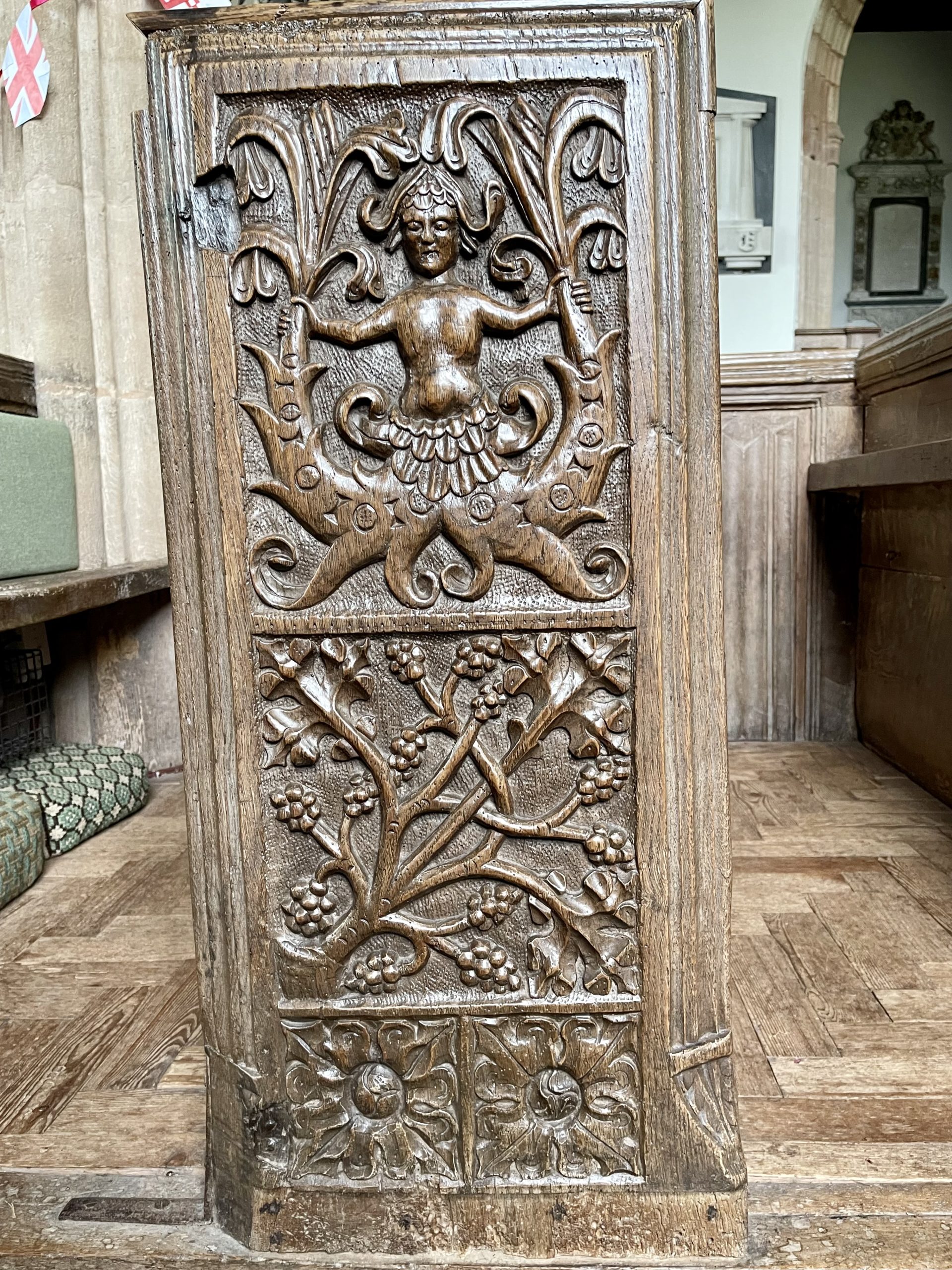
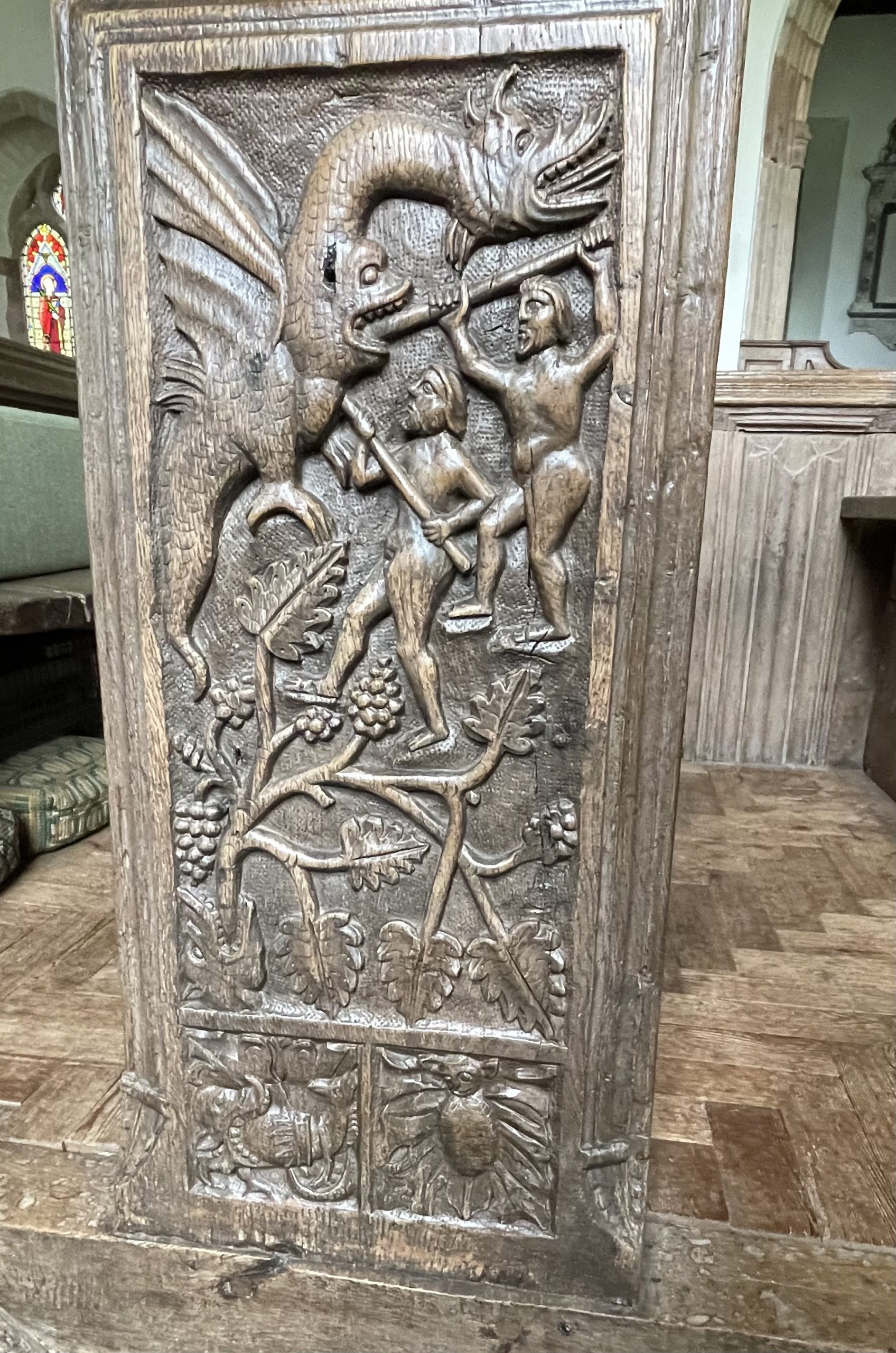
The church was like most in those parts: a tall, square tower topped with blunt pinnacles, fronting the rest of the building, all of dark stone. Always a little gloomy, even daunting, those churches. Inside it was a different story. Crowcombe’s church was known for its intricately carved bench ends on the pews. Hard to say how old they were, but they dated from the middle ages, at least.

Crowcombe Church of the Holy Ghost, 2023.
The carvings were lovely to look at, but what made them special were images from old Somerset tales, told to generations children by parents. Several depicted the legend of the Gurt Worm, a dragon, and the fearsome battle where two men cleaved the beast in half. This, so the story went, was how two local hills were formed, back at the beginning of time. Crowcombe children at least had interesting things to see, should a sermon be too dull.
The church’s carved pew ends depicting local legend of the
Gurt Worm

2023 Will had been born in 1804 in the village of Stogursey on the northern edge of the Quantocks, to parents Thomas Newton, a butcher, and Martha Buller. 2
Many Newtons had married into families from surrounding towns and villages: Bridgwater, Bicknoller, Combe Florey, Nether Stowey. His parents had lived at Nether Stowey when they married, then Crowcombe for a time, but moved to Stogursey before his birth.3 Stogursey had an old water mill, the ruins of a castle, and a cheerful brook that ran through pastures at the edge of the village. It was a pretty place, but not always easy to make a living for people of limited means.


Above: Scenes from Crowcombe, Stogursey & Nether Stowey in Somerset, in 2023
Will’s mother Martha came from a better-off family; her father and grandfather had both owned land, and were considered ‘gentlemen.’ Her father, George Buller, had left a will, in which Martha inherited an equal share of the property—with the provision that, should any one of his six children quarrel about the will or challenge it, they should be cut out without a shilling and their part divided among the rest.4 Perhaps after all, it was less troublesome to be a tenant farmer or employee with little to leave when you died, other than memories.Most folk around the Quantocks made their living as labourers on farms, harvesting apples for the tasty Somerset cider; here and there a saddler, carpenter, or cordwainer (shoemaker.) There was also work to be found in the all-important wool industry, from shepherding to wool washing.
West country folk were proud of their independent nature, the bounty of their land, their small communities that wrapped like comforting blankets around individuals and families.
The youngest of five children, William had learned to read and write—both he and Ann signed their own names on their marriage record.5 He had probably received a basic education in the local parish charity school.
He’d taken up his father’s trade of butchery, which should have brought in a reasonable living. But his family had grown, with seven children; downturns in the economy meant unemployment, rising food costs, and less money for people to buy his meat. New machines and factories replaced workers on farms and home-based producers of goods, like rope makers, weavers or straw plaiters.
Though far away from London, the seat of government and royalty, Somerset was affected by these changes as much as the rest of England.
In the public houses and the market, there was talk of opportunities for emigrants to the southern colonies. Should he apply for assisted passage under the generous terms offered by the colonial government? Skilled men such as himself were in demand; and colonists also wanted domestic staff. Ann had experience as a housekeeper, while their three older daughters were housemaid and needlewomen, and son Thomas had taken on the family trade of butchery. All the youngsters could read and write, except for John; the lad was only eight and still learning. He’d be able to to continue his schooling on the voyage, at daily lessons given to the children on board.
The passage for one person to Australia was beyond William’s reach; for a family of nine it was impossible. Under the Bounty Immigration scheme, the government would pay the passage of those it thought would be useful in the colony.
To leave behind family and home, likely forever—it was not something a man would consider asking his wife to do if the rewards weren’t likely to be considerable. There were many risks; things could so easily go wrong. Still, they had to think of their youngsters and hope that they’d all find better prospects in the colony.
Ann Long was from Dunster, on Somerset’s northern edge. From the nearby beach she could look across the Bristol Channel to Wales. It used to be a busy port for trade in wool, wine and grain. Since the sea had retreated several hundred years earlier, it had become a centre for cloth manufacture: Dunster woollen cloth was rightly famous throughout the whole country.
Walking through the village, under the gaze of Dunster Castle on its lofty hill, Ann would have passed the ancient octagonal Yarn Market, a reminder of the days when the town dominated trade in wool and cloth.

Above: Dunster Castle on the hill; and the medieval era yarn market in the village centre, 2023
Ann’s father was William Long, a saddler: a skilled occupation which easily supported his small family of wife Martha Headford and their three children.
While still a single woman, Ann had given birth to a daughter in 1825. She’d had to endure the sting of seeing baby Eliza described as a base-born child in the baptismal record.6 After Ann and Will married at the majestic Church of St George in Dunster in 1827, that no longer mattered: they were a family, though Eliza kept her mother’s maiden name of Long.
The family had settled at Tower Hill in Stogursey, just across the hills from Crowcombe. Ann’s father went to live with them after the wedding, since his wife had died the previous year.7 Other children arrived quickly: Martha in 1828; Mary Ann the year after; Thomas in 1833. Then came Beadon in 1836, Elizabeth in 1839 and lastly John in 1841. They were all baptised at Stogursey’s St Andrew’s church.8The voyage
Now the family was preparing for the Una’s departure. Most of their belongings were stowed below decks in trunks and boxes. They’d put clothes and items they’d need for the voyage in their allotted space in the emigrant quarters. Emigrants were told that there would be very little room on board, as the ship also carried cargo for stores and households in the colony, so they had to balance the needs of their family over a voyage of several months, and limited washing facilities, with the small area they would occupy.

They had to bring their own basic cooking equipment, plates and cutlery, as well as bedding and towels; and a ‘slop bucket’ or chamber pot for use as a privy, especially at night. Each family group would be issued with daily rations to prepare meals. The food would seem very monotonous after a while: salted meat or fish, dry biscuit, porridge of oatmeal or barley, peas and potatoes, and cheese. They’d have an allowance of tea, sugar, and dried fruits such as currants. The younger children would probably screw up their faces at the compulsory doses of lime juice, which they were told would prevent the dreaded shipboard disease of scurvy. Water would also be rationed. A plain diet: but at least they’d all be adequately fed during the voyage.


Images from on board HMS Victory at Porstmouth Historic Dockyards, 2023
The assisted emigrants’ quarters in steerage was a large space divided by a long wooden table down the centre, with berths arranged in rows on the sides. Passengers constructed partitions of sorts between family groups to give some privacy; a bedsheet or blanket if they could be spared. There were over three hundred emigrants just like the Newtons: married couples, single men and women, and about eighty children and babies.
‘Immigrants at Dinner, 1844‘, engraving.
With kind permission of Australian National LibraryThe odours in the stuffy space were terrible: so many bodies together along with the smell of mutton boiling or fish frying. It was a relief to go above and breathe in the tang of the sea breeze. The unfamiliar sensations as the ship lifted and sank with the swell made moving around difficult until people found their sea legs.
The youngsters were likely brimming with excitement at being on board, running along the deck, examining the rigging and all the other unfamiliar sights and sounds. Perhaps Ann and the older children had mixed feelings. As the Una drew anchor and sailed out of the shelter of Plymouth harbour, did they look on the shores of England for the last time with some sadness, wondering what lay ahead?
As it happened, the voyage was to prove more dangerous than they could have anticipated.
They’d been warned of the usual difficulties and perils of a long sea voyage: seasickness, shipboard fever or accidents, storms, hot weather through the tropical regions around the Equator. Boredom which would set in after the first week or so: shipboard routines were important for cleanliness and health, but repetitive; and after a while the experience of being surrounded by nothing but sea became tiresome.
What they had not expected was a mutiny.
William and Ann’s story will be continued next week…
- Marriage of Thomas Newton & Edith Bossley 23 Dec; Burial of Thomas Newton 8 Feb 1690; Somerset Parish Records, 1538-1914; Reference Number: D\P\crow/2/1/1; Somerset, Church of England Baptisms, Marriages, and Burials 1531-1812 From Ancestry.com, accessed 6 October 2023; Baptism of Abraham Newton 13 Jan 1663; Marriage of Abraham Newton & Sarah Sulley 31 Oct 1701 in Phillimore’s Transcript File line number 171, Somerset Crowcombe Parish Registers; Burial of Abraham Newton 27 July 1729; Baptism of Wm Newton 24 March 1703; Baptism of John Newton 24 Aug 1748; Burial of John Newton 1 May 1789; 1653: in Somerset Heritage Service; Taunton, Somerset, England; Somerset Parish Records, 1538-1914; Reference Number: D\P\crow/2/1/1 Via Ancestry.com, accessed 22 June 2024
- Baptism of WIlliam Nurton (sic) 21 May 1804 in Somerset Heritage Service, Taunton, Somerset, England; Somerset Parish Records 1538-1914; Ref No D\Pstogs/2/1/4Via Ancestry.com, accessed 10 Oct 2023
- Marriage Martha Buller & Thomas Newton at Nether Stowey 1798, in England, Pallot’s marriage Index, 1780-1837 Via Ancestry.com, accessed 22 June 2024; Baptism Charlotte Newton 6 Oct 1800 in Somerset Heritage Service, Taunton, Somerset, Somerset Parish Records 1538-1914 Ref No D\P\crow/2/1/2 via Ancestry.com.accessed 22 June 2024
- Will of George Buller of Nether Stowey 1 Oct 1799,in National Archives, Kew Surrey, England, Records of Perogative Court of Canterbury Series PROB 11, class: PROB 11, Piece 1331 Will Registers 1799-1801 Howe Quire numbers 693-745 (1799) via Ancestry.com, accessed 5 Oct 2023
- Marriage of William Newton & Ann Long 15 Nov 1827 in England Select Marriages 1538-1973 Via Ancestry.com, accessed 29 Sept 2023
- Baptism of Eliza Long 13Nov 1825 in Somerset Heritage Services, Taunton, Somerset, Ref no D\P\du/2/1/6,Somerset, England, Church of England Baptisms, 1813-1914 via Ancestry.com accessed 7 March 2024
- Burial of Martha Long 18 Oct 1826 in England, Select Deaths & Burials, 1538-1991, Dunster, St George Parish Reg no 195 Somerset Heritage Services Ref no D\P\stogs/2/1/7
- Baptism of Thomas Newton 11/12/1831; Somerset, England, Church of England Baptisms, 1813-1914 Beadon Newton bapt. 13/10/1836; Somerset Heritage Service; Taunton, Somerset, England; Reference Number: D\P\stogs/2/1/7 Elizabeth Newton bapt 21/10/1839
Discovering family: summer ‘travels’ with my ancestors (and living relatives)

Fellow descendents of Thomas Eather & Elizabeth Lee, in the Narrabri district of NSW, at our meeting in January 2025. One of my summer highlights this year was meeting up for the first time with Eather relatives who – until recently – I did not know existed.
I was contacted last year by Brian (pictured above with his lovely wife Em and their two little boys, and his mum Pam). Brian had read some of my online writings on the Eather family story. We ended up chatting by phone for ages and as my husband and I were going to be travelling home from Queensland in early January, we later arranged for us to meet up at their property near the Namoi River.
On the day, we were joined by another Eather descendant, Steve, in the centre of the photo above.
I am not good at the whole ‘second-cousin-three-times-removed’ thing. What I do know is that all of us in that photo owe our existence to Thomas Eather and Elizabeth Lee. We are descended from three of their eight children.
If you have read my Travels with My Ancestors posts over the past couple of years to do with the Eather family history, you may recall that several branches of the original convict couple took up land on Kamilaroi country on the Liverpool Plains of NSW, around Narrabri and Boggabri. The particular post relevant to this part of the story is here.
For me, it was a double thrill. Connecting with family I had until recently not known existed, of course, and on top of that, meeting such warm, genuine, lovely people.
And secondly, walking on country near to where the second generation of Eather sons and their families worked and lived. I had pinpointed locations as best I could on maps, and pored over historic records, but until then I had not actually been to these places.
I have Brian and Steve to thank for the information relating to the specific locations of what were the properties ‘Henriendi’ and ‘Baan Baa’. I love going to places and feeling that yes, they are real locations, not just names on a map or in a historic record.


Going to this part of NSW gave me some insight into its lure for the early colonial-settlers. It is beautiful country and must have held great promise for men like Robert Eather and his brothers seeking more open land on which to graze herds of cattle and sheep.
Thanks to Steve, Brian and his family for a lovely and informative afternoon.
Vivid colonial story: ‘The Governor, His Wife and His Mistress’ by Sue Williams

The third work of Australian historical fiction by Sue Williams, The Governor, His Wife and His Mistress tells the story of the naval officer who became the third governor of the British colony of New South Wales, but also the lesser-known entwined stories of the two women who shared parts of his life.
Williams has done this twice before, with great effect. Elizabeth and Elizabeth focused on the wives of Governor Lachlan Macquarie and John Macarthur. That Bligh Girl introduced Anna Bligh, the daughter of the notorious William Bligh (of ‘Mutiny on the Bounty’ fame) who replaced Gidley King as Governor in 1808.
As with those earlier novels, this new book gives a fabulous insight into the earliest, troubled years of the colony, from the point of view of women. A point of view usually overlooked in official histories of the men who, let’s be honest, made most of the decisions in those times.
Actually, this novel gives a vivid picture of the establishment of two colonies, because Gidley King was sent to put down British roots on Norfolk Island before returning to New South Wales. The author’s research is lightly handled but readers are privy to the many difficulties at both Port Jackson (later Sydney) and the even more remote Norfolk, and the logistical, moral and emotional challenges faced by successive governors.
By most historical accounts, Gidley King was an able and a fair and even handed adminsitrator. It is in his personal affairs that the other side of the man’s character are illuminated.
In this, he was definitely a man of his time and milieu. Men of his rank and situation often thought nothing of taking a convict wife as mistress, especially on the long voyage to the colonies. By the time the transport ships arrived, many had a baby on the way.
This is what happened to Ann Inett, a seamstress who had fallen on hard times when her soldier lover was killed in the Revolutionary War in America, leaving her with two small children to raise alone. One desperate crime sees Ann wrenched from her children, transported to New South Wales on a First Fleet ship, part of the great experiment of setting up a settlement from nothing on the other side of the world. Gidley King invites her to be his housekeeper, attracted by her obliging nature and quiet demeanour and, as they say, ‘one thing leads to another…’ A very common tale, part of Australia’s foundation story.
Dare I say it, more relevant to many modern Australians than the ANZAC story?
Before long, Ann has two young children with him, they are sent to Norfolk Island to endure even harder conditions there, then he is ordered to return to England…what will become of her?
It’s no spoiler to relate the next bit. Gidley King does return to Sydney. He had promised Ann marriage on his return but instead he brings back a wife, who is already expecting a baby!
It is to the author’s credit that she manages to relate this part of the story in a way which made me want to keep reading, rather than throw the book across the room. She took me into Gidley King’s head and his world view. Not a pleasant place, I admit, but it allowed me to see the constraints (as he saw them) on his moral and personal choices. So very different to today’s views. As I often say, people are no different, essentially, but society’s beliefs and expectations certainly change over time.
And as mentioned above, he was among many, many soldiers, sailors and officers who did exactly the same thing back then. Not an excuse. Just background. Captain David Collins, for example, who became the colony’s Judge Advocate, took convict Nancy Yeates, as mistress. She features in this novel too.
The real heroine of this novel, I believe, is the woman Gidley King marries, Anna Josepha. Can you image marrying a man after a very brief courtship, then boarding a ship to sail across the world to a rudimentary outpost of society, arrive heavily pregnant, to be confronted by your new husband’s mistress and his two children with her?
It seems that this quiet, ‘plain’ little woman rose to the occasion magnificently, smoothing what must have been a fraught and humilating situation for all concerned. She built a bridge between herself and Ann, between her husband, his existing children and those she went on to have with him. She took responsibility for the education of his children with Ann (to Ann’s credit also, as this meant losing her children yet again for a time).
And in doing all this, Anna Josepha was Gidley King’s right hand in his role as administrator and as Governor, acting as informal secretary, First Lady, diplomat, helping to sooth fractious tempers and care for her husband when illness took its toll.
An old story, isn’t it? And depressingly common: the faithful, loyal wife or mistress, supporting, helping, building up their menfolk. And then being forgotten in the annals of history.
So it’s wonderful to see their stories being told, both in more recent non-fiction and through the lens of fiction as in this novel.
The Governor, His Wife and His Mistress is published by Allen & Unwin in Janurary 2025.
My thanks to the publishers and to NetGalley for an advanced reading copy to review.

Not just ‘The Birdman’ or even ‘the man’ ‘Mr & Mrs Gould’ by Grantlee Kieza

When I was in primary school I was a member of the ‘Gould League’, an organisation set up to promote interest in, and conservation of, Australia’s marvellous array of birdlife. When I think about it, it seems a little ironic that I joined this organisation, because as a child I’d developed a bird phobia (long story, but a psychotic nesting mapgie, persistent attacks from said magpie over many weeks, and my father’s rifle all played a part.) Odd, then, that I signed up to a group celebrating all things feathered.
To be honest, I think the attraction was getting club newsletters, pins and stickers in the mail.
But my memories of this time did make me keen to read Grantlee Kieza’s fat volume Mr & Mrs Gould, which tells the story of the Goulds and their family, and their own adventures with birds. Though, not just birds. John Gould developed his knowledge of many more of Australia’s unique fauna, particularly its remarkable marsupials.
So, not just The Birdman, although he was certainly known as such in his lifetime and beyond. He was acknowledged as one of the most important ornithologists of his time and one of the most important publishers of scientific works.
He and his wife Elizabeth visited Australia and he named 328 of the 830 Australian bird species, and almost all newly identified Australian birds passed through his hands during his life. (Mr & Mrs Gould p366)
A couple of years ago I read Melissa Ashley’s fictional account of the life of Elizabeth Gould, The Birdman’s Wife, so I was keen to follow with this non-fiction book. This is where the ‘not just the man’ bit of my title comes in.
Because Elizabeth played a vital role in her husband’s success.
A talented artist and devoted wife, she drew and painted many of the extraordinarily beautiful illustrations in his scientific publications, until her untimely death from an infection after giving birth to her eighth baby in 1841. Her husband was a hard taskmaster and even being heavily pregnant, or recovering from childbirth, had never been a reason for downtime; her output was astonishing and brought to life the wondrous creatures her husband was collecting, classifying and naming.
She accompanied him on collecting trips while in Australia, when transport was difficult, the climate challenging and conditions even more so.
Kieza makes the point that John’s success in his chosen field was even more notable given his relative lack of formal education and his father’s lowly status as a gardener. He attributes much of this to the man’s personal drive and ambition, hard work and a streak of ruthlessness, but also includes Elizabeth’s unwavering support and sacrifice as a crucial factor.
Modern readers may well be horrified by the accounts of the jaw-dropping number of creatures that perished in the name of scientific research then. So many beautiful and even rare creatures died at the point of John’s double-barrelled shotgun, or those of his collectors. My feelings of revulsion were only slightly tempered by remembering that this was a time before photography, when specimens had to be killed and their skills preserved in order to be studied, classified and drawn. Taxidermy was hugely popular among natural scientists, but also collectors, hunters and the wealthy who followed the dictates of fashion and fads. John himself began his career as a taxidermist. I understand the context and limitations of the era, but still experienced a stomach-turning dismay at the many accounts of mass slaughter of creatures in the name of science.
Like many ambitious young men of his day, Gould spent as much time as he could hunting for wildlife to trap and kill, ironically in order to make them as lifelike as he could. If trapping didn’t work, he had his muzzle-loading shotgun.
Mr & Mrs Gould, p21
There is much in this book to enjoy for those interested in the history of this period, including Gould’s connections with many famous people from the era. Joseph Banks, Sir Stamford Raffles, Edward Lear, Tasmania’s Governor and Lady Franklin, the eccentric and doomed explorer Ludwig Leichhardt and Charles Darwin are all figures from history whose stories connected with the Goulds.
The narrative is engrossing, though rather detailed in parts; however it always returns to the very human story at its centre. Gorgeous glossy coloured plates demonstrate the talent of Elizabeth and the other artists who worked so hard to bring Gould’s newly identified creatures alive on the page.
Mr & Mrs Gould was published by HarperCollins in October 2024.
My thanks to the publishers for a review copy.
Powerful family story: ‘Tears of Strangers’ by Stan Grant

The title of this extraordinary memoir is from a Russian proverb: The tears of strangers are nothing but water. These words echoed in my mind as I read this story of his family, that is also a powerful and sometimes challenging examination of the concept of race, of Australian history, and the author’s own position within the black and white worlds of modern Australia. It’s also a call for empathy: for Australians of all backgrounds to learn and understand the historical events that have shaped us all, and to feel more than indifference at the past and present suffering of others.
It is beautifully written, canvassing his own family’s roots in both black and white Australia and the complications and challenges that involves.
He is searingly honest, writing as he does about his relationships with family members, his search for truth, and his hopes for a better future for all First Nations people. The narrative does not skirt around issues such as violence, alcohol and drug use, poverty, incarceration. He describes the so-called ‘Bathurst Wars’ and other conflicts where whites and indigenous communities clashed over encroaching white settlements, and the sickening violence that occured there and in many other parts of the country.
He describes indigenous heroes of history and more recent years, tracing the steady thread of resistance since white settlement. Contrary to past assumptions by many, Aboriginal people did not meekly submit to colonisation. We should all know more about these figures from the past, who were at the time regarded by white settlers and authorities as troublesome, criminals and threats, but to their own people were freedom fighters.
As a way to learn about these and other aspects of Australia past and present, I can highly recommend Tears of Strangers. It’s focus on the micro, on positioning one person and his family within the context of wider events and the past, allows readers to read with empathy.
Part of this search means unlocking secrets, always painful and often tragic. I hesitate now as I stare at a blank page that I know I will soon reveal perhaps more than I would like to. But the truth demands courage. I hope only one thing: that one day Aborigines can be free of the all too painful choices our blackness has forced upon us.
Tears of Strangers (loc 8% ebook version)
Tears of Strangers was published by HarperCollins in 2002; the edition I read published 2016.