‘In-betweenness’: ‘The Cult of Romance’ by Sarah Ayoub

In a classic case of judging a book by its cover, my first thought on picking up The Cult of Romance was ‘Oh no, another YA novel drenched in teenage angst about boys!’
Well, I am here to admit that in that, I was wrong: thoroughly, comprehensively wrong.
What Australian journalist and author Sarah Ayoub has written is a funny, wise and very relevant portrayal of growing up in multicultural Australia. All about identity, culture and belonging, it explores what it means to be a young Lebanese-Australian women – and a feminist – while trying to be supportive as your best friend heads towards a ridiculously young marriage.
The novel is full of amusing asides such as: 5 things you expect your best friend to bring back from a Lebanese holiday (the list does not include an engagement ring), that highlight the sometimes difficult, often funny, aspects of contemporary life for the children and grandchildren of immigrants.
Crucially, it explores the ‘in-betweenness’ of these young people : there is the traditional culture of the homeland as it was when the parent / grandparent left that remains real to that family member; the contemporary society that has developed there since they left; and the world inhabited by the young person who was born into a different country and culture.
The protagonist, Natalie, comes face to face with this when she travels to Lebanon for her friend’s wedding, as she is confronted with all that she doesn’t know or understand about the country that her grandmother, her Tayta, had left so many years before.
That night as I lie in bed, I think about my inheritance. Not a house or money or family heirlooms, but that very feeling of straddling two separate identities, crystallised in small moments, like that one on the train today. Lebanese stories on Australian trains, being told to sit like a girl, judgement for my otherness in my own homeland. ‘Your mother made such an effort to teach you Arabic,’ Tayta had said.
The Cult of Romance p115Natalie is an engaging and believable character and I admired her strenuous efforts to understand and to learn. There is a romantic thread (which is in itself interesting as Natalie is a self-proclaimed ‘anti-romantic’) but the true arc of the story is her journey to more understanding and acceptance of herself and others.
The Cult of Romance is a terrific book for young people to enjoy and to reflect on the differences and similarities that make us human.
It was published by HarperCollins Publishers in May 2022. My thanks to the publishers for a review copy.

“Gus and the Starlight’ by Victoria Carless

It’s rare for a novel aimed at middle grade readers to deal openly with issues of family instability and broken or difficult parental relationships. Aussie author Victoria Carless has achieved this, while imbuing her story with a sense of hope (and a smidgen of the supernatural).
Gus is twelve. At the novel’s opening she is in a car with her mum, older sister Alice and little brother Artie. They are driving through the day and night – actually, several days and nights – heading north to Queensland. Her mother, Delphine, is escaping another difficult boyfriend, looking for a fresh start with her kids, somewhere where Troy won’t find them. Equally importantly, she wants to find a place to live where the locals won’t know about her work as a spiritual medium, which she’s keen to leave behind because of all the sadness it brings.
So, not entirely a ‘regular’ family then, especially as it becomes clear that the girls of the family tend to inherit ‘the gift’ (connecting with the dead) at puberty. Will the gift – or curse, depending on your viewpoint – manifest itself in Gus and her sister?
The family lands in the small township of Calvary, surrounded by sugarcane fields, where Delphine plans to restore and run the long-neglected drive-in cinema, the Starlight.
Gus has learnt long ago not to put down roots, make friends, or get used to the places that her family stay in, because it’s too painful when the inevitable happens and they have to leave. Despite herself though, she becomes fascinated by the workings of the old-fashioned film projection equipment and learns to operate it, with the help of Henry, who may or may not be a ghost.
The descriptions of the drive-in and the surrounding Queensland countryside are vivid and will resonate with anyone who remembers drive-ins of yesteryear, or who has driven through such semi-tropical parts of Australia. The novel is, in a way, a homage to some of the terrific films of the 1980’s and 90’s, such as ET, Strictly Ballroom, Ghostbusters, and The Princess Bride. Each film has something to say to Gus and to the locals, who eventually flock back to the drive-in.
Their landlady, Deidre, proves to be problematic, but by the time of the showdown, Gus and her family have developed a degree of self awareness and confidence and prove to be more than a match for their bullying landlady.
Gus and the Starlight is part coming-of-age story, part magical realism, and all heart.
It was published by HarperCollins Children’s books in May 2022.
My thanks to the publisher for a review copy.
Another celebration of diversity: ‘How Do You Say I Love You?’ by Ashleigh Barton & Martina Heiduczek

How Do You Say I Love You? is a new picture book in a gorgeous series by author Ashleigh Barton and illustrator Martina Heiduczek, celebrating languages and cultures from around the world. Previous titles are What Do You Call Your Grandpa?, What Do You Call Your Grandma?, and What Do You Do To Celebrate? (links are to my reviews.)
As well as the focus on the beauty of human expression, something all the books have in common is celebrating connection: through family, friends, community.
Each double page spread shows a child saying ‘I love you’ in their language to someone special in their life. We see children from places as diverse as Peru, Iran, Canada, Tonga, West and Central Africa, Egypt, and more, with grandparents, pets, parents, friends. Languages include Auslan (the Sign Language used in Australia) along with Farsi, French, Arabic, Korean, Filipino, Mandarin, Spanish and Italian.
The beautiful illustrations invite close examination and convey the message of commonality and diversity which all these books so skillfully portray.
How Do You Say I Love You? is a perfect read-aloud book, a beautiful way for youngsters to be introduced to the wonderful world of languages.
It is published by HarperCollins Children’s Books in August 2022.
My thanks to the publishers for a review copy.
Touchy-feely: ‘That’s Not My Turtle!’ by Fiona Watt and Rachel Wells
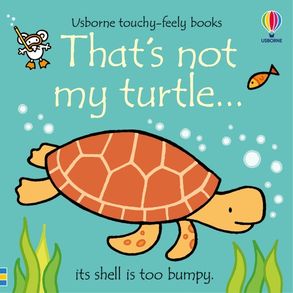
If you have ever had anything to do with sharing a book with a very young baby or child, chances are you’ll have come across one or more of the Usbourne ‘Touchy-feely’ series of board books.
Title include That’s Not My Kitten, That’s Not my T-Rex, That’s Not My Teddy, That’s Not My Tractor, That’s Not My Elephant… you get the idea.
Each sturdy little book features aspects of the creature or object in question, with tactile cutouts on each page allowing small fingers to experience the various parts that don’t measure up.
In this case, it’s the turtle’s flippers that are too scaly, the tail too rough, the eggs too smooth…until on the last page, the correct turtle is identified by its shiny tummy.
Along with the tactile features, the repetition of the format in the series, and within each book, allows little ones to anticipate and participate in the story.
This new title will sit happily alongside its Touchy-feely brothers and sisters in the book basket or on the shelf. They are cute, affordable and (almost) indestructible little books that tiny people will love.
That’s Not My Turtle is published by HarperCollins Children’s Books in September 2022.
My thanks to the publishers for a review copy.Terrific new children’s fantasy: ‘The Callers’ by Kiah Thomas

The Callers is a fabulous new book for middle-grade readers, particularly those who enjoy immersion in a skillfully drawn fantasy world that prompts consideration of the challenges facing our own.
Quin is the son of Adriana, the powerful head of the Council of Callers who rule the continent of Elipsom. ‘Calling’, the ability to conjure anything out of thin air, is in the DNA of his family and has been for generations.
But Quin is different. He cannot Call, which puts him at odds with his mother and his talented sister Davinia, and also with the expectations of his world.
When he discovers that the objects Callers bring into Elipsom are actually taken from another place where people also live, he decides to do something to change this.
He meets Allie, a girl who is also on the path to correct this long-standing injustice, and together they embark on a quest to preserve the future of Allie’s land. But Quin is now heading for a headlong collision with his own family.
This novel can be read as a sustained and sensitive metaphor for the risks of the environmental degradation facing our own planet, and also for the injustices perpetrated by centuries of colonialism. Is it fair that some should benefit from other’s loss?
The story is deeply engrossing and I loved that there was no need for pitched battles or physical violence in Quin’s and Allie’s efforts to change their world. The two work together, using their existing skills – and some previously undiscovered talents – to overcome the obstacles in their way.
Quin is uncertain, confused about his place in his family and society. Allie, on the other hand, is passionate and courageous and she shows Quin the reality of their two worlds, and how he can live in line with his own beliefs and feelings. There are many profound questions addressed in this slim novel, but it is such a great story that it’s never a lecture. I really cared about Quin and Allie and their quest.
It’s also, in a way, a coming-of-age story, about growing up and seeing your world, and the adults in your life, through a different lens:
His head was throbbing. How would he ever know what he believed anymore? Half of him wanted to simply dismiss what Allie was telling him. It would be easier to go on believing what he’d always known to be true. And who was this girl to tell him that every single thing about his life was a lie? What could she know?
The Callers p86I loved this book right away and I hope Kiah Thomas writes more stories like this.
The Callers was published by Harper Collins Children’s Books in May 2022. My thanks to the publishers for a review copy.
Women in wartime: ‘The Light We Left Behind’ by Tessa Harris

One of the most welcome aspects of the current trend in historical fiction publishing is the space created to tell the stories of women and the part they played in well-known – and sometimes, lesser-known – historical events. The Light We Left Behind is one such novel, focusing on the contributions made to the Allied war effort by the women and men who worked at Trent Park.
Trent Park? Never heard of it?
If that’s your reaction, rest assured it was also mine.
Like the more famous Bletchley Park, Trent Park was a centre of intelligence gathering during WWII that was like no other in Britain at the time. A stately home outside London, it was turned into a prison for German POWs. A prison with a difference: Trent Park housed high ranking German officials and military officers in luxury, catering to their expensive tastes and providing entertainment and every comfort.
You might be thinking ‘If the long-suffering British public had known of this place, there would have been an uproar’, and you would be quite correct. Trent Park’s real purpose was kept hidden even from the locals. The house and its grounds were fitted out with listening devices, and German speaking employees (sometimes refugees from Nazi-occupied territories) brought in to interpret what the German captives were saying to each other when they were alone – strolling the grounds, smoking cigars and drinking fine wine in the library.
The prisoners were interrogated, of course, but the methods of interrogation tended to be gentle, employing psychological strategies rather than brute force. And the arrogant German generals and officials would boast amongst themselves about what they had not divulged to their interrogators, unknowingly providing information to the Allies about weapons development and war strategies that would otherwise have remained hidden.
This fascinating centre of wartime activity provides the backdrop for the story of Maddie Gresham, a psychology student who had studied under the professor whose theories informed the establishment of Trent Park. Maddie is tasked with gaining the Germans’ trust and getting them to reveal more information.
Maddie’s pre-war and wartime lives collide in the form of Max Weitzler, whom she had met and fallen in love with years before on a visit to Germany. What happens to Max’s German father and German Jewish mother shows how the Nazis’ racist policies so bitterly divided the country and tore families apart. Max’s appearance at Trent House brings with it both joy and potential disaster for Maddie.
Maddie’s story illustrates how people’s emotional concerns and preoccupations can exist side-by-side with the pressing concerns of wartime work or survival: they are important parts of a character’s make-up and should not be ignored. For me, this results in a more satisfying and realistic picture because for all of us, while our lives may be transformed by external events such as war or disaster, our internal lives continue.
The Light We Left Behind joins other novels (such as The Rose Code or The Codebreakers) which feature the valuable work done by women in complex wartime circumstances. It’s an engrossing, heartfelt portrayal of the difficulties faced by ordinary people doing extraordinary work in incredibly challenging times.
The Light We Left Behind is published by Harper Collins in July 2022. My thanks to the publisher for a review copy.

‘The Brightest Star’ by Emma Harcourt

Recently I have noticed a heartening bounty of books being published that feature women striving and achieving in areas traditionally the preserve of men. It’s a timely redress of a centuries-long imbalance. The Brightest Star is a terrific example.
Set in Renaissance Florence, it tells the story of Luna, a child born under a full moon and in the eyes of many, doubly cursed, as she was born with a crippled foot and her mother died shortly afterwards.
Luna is raised by her father Vincenzio (a prosperous wool merchant with an appetite for learning, particularly in the burgeoning field of astronomy), her stepmother and two half-siblings. She has a happy childhood, despite her disability, as she has a quick, intelligent mind and a love for learning, which her father indulges – until Luna grows ‘too old’ for such interests, which are seen by most as inappropriate for a young women.
To make matters worse, Florence has fallen under the spell of the fanatical preacher Friar Girolama Savonarola, who rails against all earthly pleasures and any view he regards as heresy. The powerful Medici family, who Luna’s father secretly supports, have been banished from the city. These are dangerous times for anyone who questions accepted orthodoxies or who longs for a different life than that set out by church, family and society.
The reader is plunged into the world of Renaissance Florence: the petty concerns of society are contrasted with ground-breaking developments in science, mathematics, philosophy and the arts; the blossoming of intellectual thought collides with the fundamentalism of Savonarola. Luna’s interests and abilities lead her into conflict with the norms and expectations of her society, just as her father’s political views result in danger for the entire family.
The hold of the Friar over the great and good of the city has echoes of modern so-called ‘leaders’ whose followers similarly suspend rational or independent thought and swallow all they are told, no matter how improbable or dangerous the lies become:
It was very clever the way the preacher stood in the halo of luminosity, just as he spoke of the divine light the Lord had sent to him. All around, people murmured in agreement with his words and Vincenzio was astounded. Was he the only sane man to hear the brittleness in the hollow-cheeked voice? How could Savonarola speak of a new era of universal peace whilst ransacking the homes of good citizens and banishing others? Discord was growing and word had travelled that Florence was becoming unstable, yet the people believed the preacher’s promise of riches, glory and power.
The Brightest Star p138-139Sound familiar?
Reading this book, I had a sense of the ebb and flow of human knowledge; the theories of the ancient Greeks more advanced than some of the ideas of mediaeval Europe; some of the ingrained assumptions about women almost as familiar today as they were over six hundred years ago. Characters from history appear in the novel’s pages, inviting recognition: Leonardo da Vinci, Botticelli, Machiavelli and Copernicus, to name a few.
The Brightest Star is a welcome addition to the growing number of historical novels in which women’s aspirations and abilities are centre-stage, in settings where such things could be dangerous.
The Brightest Star is published by HarperCollins in July 2022. My thanks to the publisher for a review copy.


Secrets: ‘The Silence of Water’ by Sharron Booth

Are some secrets best left buried in the past? Should we know everything about our forebears’ lives: including things they would much prefer remained hidden? Do the actions of the past affect descendants, even generations later?
These are some of the questions explored in Sharron Booth’s debut novel, a work of historical fiction that builds on her extensive research. Regular readers of my blog will know that I am a sucker for fiction inspired by real-life people and events: it is what I most love to read (and write).
The Silence of Water joins other books of this type that I have admired, including Kate Grenville’s The Secret River. It’s a complicated book, told from the experiences and points of view of three characters across three generations of people.
Fan is unhappy at her parents’ decision to move from Adelaide to Western Australia to take care of Fan’s elderly grandfather, Edwin Salt, a man she has never met and knows nothing about. She develops an unexpected relationship with the old man and becomes curious about his past, as veiled references and clues emerge. When she goes digging for further information about Edwin, she stumbles across long-buried secrets that upset her view of the world and her family.
The narrative moves from South Australia in 1906, backwards in time to Lichfield in England where Edwin lived with his family in the 1840’s; in between are the experiences of Agnes, Edwin’s daughter and Fan’s mother in Perth.
These settings and times are the warp of the book; the stories of Edwin, Agnes and Fan are the weft, slowly revealing the true picture of the family and its origins as the novel progresses. Fan’s curiosity about her family’s past and its people is beautifully portrayed:
”You’ve got such a lost look about you, poor little bird.’ Ernest rested his hand over hers. ‘Now you know where you fit…. At grandfather Samuel’s funeral, my mother told me that Saint Mary’s was full to the gunnels. Brothers, sisters, aunties, uncles, rows and rows of cousins just like you and me, and all those screaming brats that our grandfather’s second wife kept popping out every year like Christmas puddings.’ Ernest drew an enormous circle around the entire family. ‘The point is, all those people in the church that day were your people, Agnes. Every single one.’
The Silence of Water pp79-80
Agnes stared at Ernest’s drawing. So many names, she could hardly take it in.The rich historical detail gives us an insight into how Western Australia must have appeared to the earliest British settlers and convicts; and also an indication of how late the convict transportation system continued into the western colony (until 1868), having ceased in the eastern colonies by the 1850’s.
The Silence of Water was shortlisted for the 2020 City of Fremantle Hungerford Award for an unpublished manuscript. It tells a complex web of stories from one family and provokes questions about whether family secrets are best told or kept hidden. I thoroughly enjoyed this book and would recommend to readers who enjoy stories about Australia’s past.
The Silence of Water is published by Fremantle Press in May 2022.

Beloved Aussie star & children’s books: ‘Little Ash’ series


Ash Barty, three-times Grand Slam tennis champion and much-admired young Australian First Nations woman, has excelled at tennis (obviously!) and also cricket. I suspect she would shine in any sport she chose to try.
Apart from her amazing sports success, Ash has earned admiration for her positivity and kindness, both on and off the court and playing field. She has become a role model and her example is a shining light for aspiring sports players of all ages.
Who can forget the look of unalloyed surprise and joy when Ash was presented the 2022 Australian Open winner’s trophy by none other than her own role model and Australian tennis legend, Wiradjuri woman Evonne Goolagong-Cawley?
After her retirement from professional tennis this year, Ash has moved on to other endeavours, including collaboration in a new series of books for young readers called Little Ash, featuring her own younger self in various adventures that children will relate to. The settings are at school, and various children’s sports activities.
The little books are perfect for early readers, light and easy to hold in little hands with very short chapters and lots of black and white illustrations throughout.
Co-authored with Jasmin McGaughey (a young author with Torres Strait Islander and African American heritage) and illustrated by Jade Goodwin (who has Gamilaraay heritage), this book series is a welcome addition to books for children and young adults by First Nations authors and illustrators.
The first four books in the Little Ash series are published by HarperCollins Children’s Books in July 2022.
My thanks to the publishers for review copies.
Gentle introduction to dementia for kids: ‘Dancing with Memories’ by Sally Yule & Cheryl Orsini

If you’ve followed by blog for a bit you’d be familiar with the series of posts I wrote called Travels with my Mother, all about my journey with my Mum’s dementia. Mum passed away last year but the memories of her experiences, and the family’s with her, are still quite fresh. So I was keen to read Dancing with Memories, a unique picture book by Australian dementia care worker Sally Yule and illustrator Cheryl Orsini.
I love the idea of introducing this often misunderstood condition to kids, in an age-appropriate and gentle way. I also applaud the themes of respect, dignity and agency for the person with dementia. Another special thing about the book is that it contributes to understanding of brain health through a little Q&A at the end of the book (by Professor Ralph Martins) and some healthy recipes from Maggie Beer. In this way, the authors plant the idea that brain health starts young!
Best of all, the book tells a story, all about Lucy, who is excited about going to her granddaughter’s wedding.
I am Lucy and I dance with memories.
Dancing with Memories
Sometimes I remember.
Sometimes I forget.
Sometimes I remember that I forget.
Sometimes I forget that I remember…
My doctor says I have dementia.
I wish I didn’t but I do.
‘Your brain has changed’, she says, ‘but you are still Lucy.’
She knows that I have a brain AND a heart.Young readers will go with Lucy on her adventure: she gets lost on her way to the wedding, but a supportive community and local friends set all to rights again and by the end of the story, Lucy is dancing with her granddaughter, along with her memories.
The illustrations are gentle, joyful and colourful and they help to centre the person with dementia within their family, home, and neighbourhood – which is as it should be.
I would suggest that every doctor’s waiting room should have a copy of this book, as well as public and school libraries and places offering services to people with dementia and their families. It will go a long way to demystify the illness and allow kids to continue to love their family member or friend with dementia without feeling frightened or confused.
An interview with the team behind the book can be found here, if you’d like to know more about the project.
Dancing with Memories is published by HarperCollins in July 2022.
My thanks to the publishers for a review copy.


