World Between Blinks #2: ‘Rebellion of the Lost’ by Amie Kaufman & Ryan Graudin

Yes! Another instalment in the World Between Blinks, what I hope will become a long series for middle-grade readers. I loved Book 1 (here’s my review) so this sequel was very welcome.
Book 2 continues the magical, sometimes chaotic, occasionally scary but always fun world of the Lost. Every item, person, geographical feature and building in the world that has been ‘lost’ to history, ends up in this world. The problem is that the Administrator, in charge of the team of Curators who log and document all the comings and goings of things, has decided it is all way too chaotic for his liking.
So, he implements strict new controls designed to restore order. The unintended consequences of these rules are separated families, bored inhabitants, and a sterile, humourless World. Enter the rebels: all those who want to see their World returned to the creative, beautiful place it had been.
Cousins Marisol and Jake, along with Marisol’s older, teenaged brother Victor, are drawn back to try to assist the rebels. What follows is a rollicking adventure with some fearful moments, new friendships and old ones rediscovered.
On the way, Marisol and Victor learn some new things about each other and get to see their sibling in a new light. This insight stretches to others in the World: a beautiful metaphor for how, if we only stop to look, we can realise that people are not all ‘bad’ or ‘good’ – even individuals like the Administrator has an inner life that guides what he does, even if somewhat misguidedly.
‘That’s the thing the Administrator doesn’t understand, or doesn’t want to understand. Put everyone back in their zones, and they’ll be exactly the same forever. But everything changes. I’m not the same person I was back home. I used to think some things, say some things that – well, I’ve learned a lot. That’s what happens when you’re always exploring. You learn new lessons.’
Rebellion of the Lost p139The Administrator has the power to ‘flip’ the hourglasses of every person in the World, thus erasing their memories. The process and its result is rather like an accelerated version of what happens to a person who suffers from a dementia illness such as Alzheimer’s. This could be a good analogy to explain what that disease is, for youngsters who have a family member diagnosed with it.
On a personal note, I was intrigued that the ‘lost mountain tops’ in the World includes Mt St Helens, the volcano in America’s Washington State that literally blew off its peak in 1980. I’d spent a year in Washington State in 1979 and was very familiar with how that particular mountain top had looked before it became ‘lost.’
I’m looking forward to Book 3 in the World Between Blinks series!
The World Between Blinks: Rebellion of the Lost is published by Harper Collins in February 2022.
My thanks to the publishers for a review copy.
Colonial women: ‘No Hearts of Gold’ by Jackie French

Some girls are born to be loved,
No Hearts of Gold
Some are born to be useful,
And some are born to be bad…The strapline of Jackie French’s new historical fiction sums it up: not all colonial women in Australia were wives, mothers, convicts, or servants.
No Hearts of Gold is about three very different women: one from aristocratic English society; one of a sturdy business-minded nature; and one from a self-made-gone-bust family. They are brought together on a voyage from England to the colony in the 1850’s; the beginning of a complex but staunch friendship against all odds.
What they find in the booming, bustling, troubled colony defies their own expectations.
The three women embark on lives very different from the ones they may have envisaged for themselves, back in England.
Kat, daughter of a fond father whose fortune disappeared with the bust of railway shares that had created it in the first place, makes the quick marriage arranged for her by an aunt. While such a fast marriage seems improbable, they were surprisingly common at all levels of society then, especially in far-flung outposts like Sydney. Marriage offered protection, financial support and a chance to leave the past behind.
Titania launches a business provisioning the ships leaving the wharves, profiting from her acumen and hard work, but dispensing kindness and help to others where she can.
Wealthy, loving Viola lives with her guardian, Cousin Lionel, in the lavish house funded by her own inheritance.
It’s difficult to say much more about the plot while avoiding spoilers. So I will instead focus on the issues and themes canvassed in the novel.
The Gold Rushes play a major role in the plot line and set the scene for some of the drama. But the focus is also on the destructive nature of these crazy events: on families, on homes and businesses that overnight lost fathers, husbands, workers. And especially, on the fragile environment of this land.
… the vegetable gardens, the fruit crop, the supplies in their storeroom were a treasure now – a treasure that could keep you alive, when specks of gold could not, and envied by men who had forgotten laws and rules, even if they had once obeyed them. There was no one they could ask for help…
No Hearts of Gold p177Women’s lack of ownership over their wealth, possessions, future and even their children, and the control wielded by men, is another important current running through the novel. As is the ways in which many women, including our three protagonists, defied the systems and conventions that kept these inequities in place.
An unexpected twist turns the story into a mystery involving a possible murder, a bushranger and a police detective.
The novel packs in all this and more: but I think, at its heart is the precious nature of enduring friendships between women.
Viola closed her eyes in sudden, deep pleasure. A friend one could say anything to. A friend who took you seriously, and not as a child, or one who must live up to the concept of ‘lady’.
No Hearts of Gold p171No Hearts of Gold is another beauty of a Jackie French novel: a gripping mystery, a rollicking yarn, and an elegy to women’s strength and courage in a society that discouraged both.
No Hearts of Gold is published by Angus & Robertson, an imprint of Harper Collins Punishers, in December 2021.
My thanks to the publishers for a copy to read and review.


Words & numbers for sharp-eyed youngsters: ‘Mrs Koala’s Beauty Parlour’ by Catherine Jinks and Tania McCartney

Mrs Koala’s beauty parlour is so busy, with a succession of alliterative critters lining up to receive the feel-good ministrations of a skilled beauty therapist.
Each double page spread features different services offered by Mrs Koala, with fun for little ones who can join in the countdown, alliterative text and searching for the beauty parlour key, cleverly hidden in each scene.
There are 10 fancy frogs getting facials, 9 pampered porcupines getting perms, 8 trendy tigers getting trims, and so on, right down to 1 ‘kaput koala’ on the final page – Mrs Koala is tired after all that work!
The attractive colour illustrations by Tania McCartney invite close examination of each busy scene – and of course little ones will love to find the key on each page.
This is a sweet book that simply begs to be read aloud and I’m sure will be a favourite at story time.
Mrs Koala’s Beauty Parlour is published by Working Title Press (an imprint of Harper Collins Children’s Books in February 2022.
My thanks to the publishers for a review copy.
2022 Reading Challenges
I’ve enjoyed participating in several reading challenges over the past few years. Kind of like being in a book club, it is an added incentive to read beyond my ‘usual’ genres, and especially to explore new authors or styles of writing.
For 2022, here’s what I am aiming for:

The Australian Women Writers Challenge has been going for 10 years and I’ve participated in the past few years.
In 2022 the AWW blog will focus on ’19th and 20th century writers including authors who may not have achieved prominence in their lifetimes, or whose works have been forgotten and/or overlooked.’ I will join in discussion of contemporary Australian women writers in the AWW Facebook group Love Reading Books by Aussie Women.
(No need for me to set a goal for this as I already ‘love reading books by Aussie women’!)
The Aussie Author Reading Challenge hosted by Jo at Book Lover Reviews is a fun one for me: I love to read books by the amazing talented authors we have in this country. This year I will go again for the ‘Kangaroo‘ level, which means I will read and review 12 books written by Australian Authors, of which at least 4 of those authors are female, at least 4 of those authors are male, and at least 4 of those authors are new to me; Fiction or non-fiction, at least 3 different genre.

Historical fiction reading challenge hosted by the Intrepid Reader : This year I will take on the ‘Mediaeval‘ level, meaning I will tackle a goal of reading 15 books during the year.

Non Fiction Reading Challenge hosted by Shelleyrae at Book’d Out. I’ll go for the ‘Nibbler‘ level: 6 books, one from any 6 of the listed categories:
1. Social History 2. Popular Science 3. Language 4. Medical Memoir 5. Climate/Weather 6. Celebrity 7. Reference
8. Geography 9. Linked to a podcast 10. Wild Animals 11. Economics 12. Published in 2022And lastly, my own informal personal challenge: Continue to increase the number of works I read by First Nations authors and/or about First Nations cultures and histories, especially Australian. There are so many First Nations authors publishing wonderful works here just now and I always love discovering new ones.
So that’s it for me for 2022. As always I expect to vary from my initial goals: either I read way more than I anticipate or miss out on a particular category somewhere along the line. It’s all just fun, and a way to be a little mindful of the books I choose.
What will be your reading goals or challenges for the year ahead? Let me know in the comments.
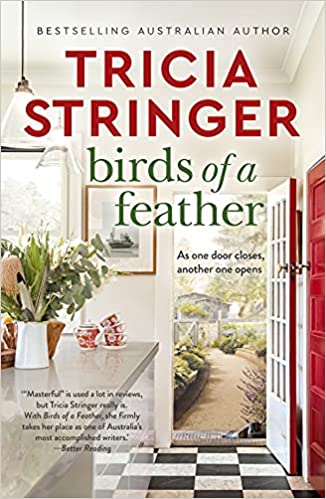
I hope you find yourself lost in the pages of excellent books throughout the year.The sweetness of friendships: ‘Birds of a Feather’ by Tricia Stringer

It’s good to branch out into a genre you don’t generally read much of, or an author not encountered before, and that’s what I’ve done with this contemporary fiction by Australian author Tricia Stringer.
Birds of a Feather is all about family and friendships, old and new. Set in fictional Wallaby Bay on South Australia’s Spencer Gulf, the story features three very different women. There is Eve, battling to maintain her independence after a crippling shoulder injury; her goddaughter Julia, struggling with suppressed grief and the sudden loss of her scientific research job; and Lucy, trying to be the best mother she can be to her two young children, and coping with the absence of her FIFO (Fly In Fly Out) husband.
The first part of the novel sets up the circumstances that bring these characters together: at first unwillingly, each feeling their way in a new situation, trying to overcome mistrust, hesitation and past hurts. Once the women are together, the story really gets going. Before that, there are hints and veiled references to their back stories, tensions, traumas and the circumstances that shaped each one, and it is fun to put their stories together as the novel goes along.
There are references to the Covid pandemic and the dilemmas faced by people like Lucy, an aged care worker, who must try to deal with an emotionally and physically draining experience while also worrying about her kids. It’s a very real scenario that brings home the additional challenges the pandemic introduced to already complicated lives.
The author captures the small town atmosphere beautifully: all the strengths of rural communities, along with the downsides that can accompany living in a place where everyone knows everybody else (and their business).
I found it soothing to be lost in the minutia of others’ lives, and the novel’s resolution was satisfying, even though some aspects felt a bit too tidy.
Birds of a Feather will be an enjoyable read for people who like to read character-based contemporary fiction about real-life struggles and challenges and the ways in which they can be overcome.
Birds of a Feather is published by HQ Fiction, an imprint of Harlequin Enterprises, in December 2021.
My thanks to the publishers for a review copy.‘Australia Remembers: Len Waters, Boundless and Born to Fly’ by Catherine Baver

Len Waters was born behind the gates of an Aboriginal reserve, but his big imagination and even bigger dreams took him soaring beyond the reach of those who tried to confine him.
Len Waters: Boundless and Born to FlyLen Waters was a Kamilaroi man who became a trailblazer: probably only the second man of Aboriginal descent to be accepted into RAAF pilot training in the 1940’s, receiving his pilot’s wings in 1944 and graduating in the top four of his class – at just 19 years old.
Len went on to serve in the RAAF in the southwestern Pacific, flying bombing missions in his Kittyhawk aircraft Black Magic. Promoted to the rank of Flight Sergeant, he continued service in the Pacific until the war ended, when he’d been promoted to warrant officer.
Despite his bravery and skillful service, Len (and other First Nations servicemen and women) discovered that their service didn’t seem to matter once they returned to civilian life, and they faced the daily discrimination and disadvantage meted out to Aboriginal people in Australia.
This lovely book weaves Len’s childhood and early life experiences, the teachings of his parents and cultural knowledge, with his hard work, dreams and dedication, to create a picture of a truly remarkable Australian.
It is aimed at primary aged children and includes many illustrations and side boxes that pose questions for readers to consider as they learn more about Len and the Australia he grew up in and returned to.
It includes accessibly presented information on many key aspects of Australian First Nations culture and history: language, kinship, totems and respect for culture and knowledge holders, the British Empire and its consequences for First Nations people across the world, missions and reserves, Stolen Generations, Aboriginal servicemen in WWI, their experiences after that war and the Second World War.
I purchased the book for my 8-year old grandson who is interested in aircraft from this period, and also in stories about Indigenous Australians. I think it will well and truly tick both boxes.
Australia Remembers: Len Waters, Boundless and Born to Fly is published by Big Sky Publishing in 2021.


Fires, climate change, and activism : ‘Burnt Out’ by Victoria Brookman

From the setting and the themes of this novel, I was not surprised to read in Victoria Brookman’s bio that she ‘is an author, activist and academic. She lives with her family in the Blue Mountains, on Darug and Gundungurra country.’
Burnt Out is not the first and certainly won’t be the last novel that deals with Australia’s catastrophic Black Summer fires of 2019-2020, when huge swathes of forest (and townships) were destroyed by out of control bushfires after years of crippling drought. It was, in many ways, a turning point for ‘mainstream Australia’ – evidence that climate change was indeed increasing the severity (and frequency) of fires and extreme ‘weather events’.
As a fellow resident of the Blue Mountains, the opening scenes of Burnt Out conjured visceral and unpleasant memories of the fear, smoke and danger of that time. Cali, a writer whose life is already crumbling around her, shelters at the home of her neighbour, Spike, while fire consumes her house, her car, her work, and her cat.
Cali vents her rage at government and corporate inaction on climate change while in front of a TV camera and journalist. Her emotional and angry outburst goes viral and her words become the hashtag of the moment: #Fu**ingDoSomething.
She is homeless, cat-less, car-less, and her publisher is demanding that she produce the manuscript she is supposed to have been writing over the previous three years, an intended follow up for her first, best-selling novel. But Cali has nothing to give them – not, as she tells her agent, because it went in the fire, but because for three years her writing has dried up. On top of it all, her husband leaves her.
Then a rich business tycoon, handsome Arlo Richardson, steps in, offering her free accommodation in his beautiful Point Piper home, space and time to ‘re-write’ her non-existent novel. Cali, bewildered, crushed, and fearing the end of her writing career, accepts. Arlo offers her the chance of a lifetime: to be the public face of a new charitable foundation which will fund action on climate change.
What follows is a twisty tale in which do-nothing politicians, the divide between Australia’s uber-rich and the rest, greenwashing, social media, the news cycle, the publishing industry, celebrity influencers, are all examined and thoroughly skewered.
I didn’t find Cali an endearing character: I tend to get rather frustrated in a novel where the protagonist is perpetuating their own train wreck of a life, and her helplessness and inability to make her own decisions were maddening. This fortunately changes towards the end of the novel and I was able to cheer Cali on when she finally gets her mojo back.
To be fair, though, Cali’s inability to get her bearings is probably a very real manifestation of trauma: the transformation of familiar landscapes, an inability to get a grip on a new reality.
As they turned down Gumnut Close, she began to doubt her own abilities. Had she directed him to take the wrong street? Everything looked wrong. There was no blue weatherboard cottage here. No bush, no wall of overgrown lilly pillies. Frantic, she looked out her window, desperate to get her bearings.
Burnt Out p132Being a Blue Mountains gal, what I also enjoyed about this book were the frequent references to familiar places (and occasionally people). While fictionalised, there were enough details to spark a pleasant feeling of recognition and a smile.
Burnt Out is published by HarperCollins Publishers in January 2022.
My thanks to the publishers for an advanced reading copy to review.Sorrowful truths: ‘Bila Yarrudhanggalangdhuray’ by Anita Heiss

The first thing I love about this new novel by Wiradjuri author Anita Heiss is the title. Translating to ‘River of Dreams’ in English, it is in the Wiradjuri language, which is also sprinkled liberally throughout the narrative. What a privilege, to be given an opportunity to understand and experience words and phrases in the language of First Nations people.
The story starts with the drama and tragedy of the devastating 1852 Great Flood of the Marrambidya (Murrumbidgee River) in Gundagai, NSW. There are shocking losses of human and lives, property and livestock despite the heroic efforts of several men from the Aboriginal camp near the river, including Yarri, the father of the main character, Wagadhaany. She works for the Bailey family, a local White family. Yarri rescues his daughter and the two Bailey men who survived the flood, from their precarious perch on the roof of the house.
The river is a central theme of the novel, a presence both benevolent and destructive. It gives life and just as easily takes it away. The flood is important, as a real historical event that highlights the skill and courage of the Aboriginal rescuers, and also as a metaphor:
…as the canoe floats with effort to the shore, Yarri thinks about the two men there together; a naked White man and a barely clothed Black man are nothing but two men stuck in the middle of a devastating flood… A life is a life, he says over and over in his mind, knowing that the weather, the rain, the river don’t care what colour anyone is right now, and that in this moment they are equal. Yarri takes a deep breath and works his arms harder than he ever has, willing them both to bring both men to shore, and wishing they were both equals every day.
Bila Yarrudhanggalangdhuray p33Louisa is the other main character: a young Quaker woman who has been recently widowed in the flood, she meets and marries James, the eldest of the two surviving Baileys. Her Quaker beliefs lead her to wish for an equal relationship with the original people of the land, and she endeavours to achieve this with Wagadhaany.
So much gets in the way of a genuine friendship. Louisa is a good example of how well intentioned White people can still end up using relationships with First Nations people for their own purposes, while still desiring to act in a benevolent manner. The most obvious way that Louisa does this is to insist that Wagadhaany accompany the Baileys when they move to Wagga Wagga. Wagadhaany is devastated to lose connection with her mayagan, her family and the Country on which she was born and raised.
This allows the reader to try to understand something of the grief and loss experienced by First Nations people since colonisation:
How can she explain to Louisa, whose family chose to live on other people’s land, that she feels her sense of identity has been robbed, that everything that makes her Wagadhaany, the dancer, has been taken from her?
Bila Yarrudhanggalangdhuray p162Louisa is in many ways a sympathetic character, and in making her so, the author goes beyond the stomach-turning racism and cruelty perpetrated by Whites against First Nations people in this country, to explore some of the other ways in which racism manifests: the more subtle, systemic and insidious ways in which unequal power and racist assumptions play out.
Wagadhaany is an intelligent young woman, trying to assert her self and make sense of a world which has changed irrevocably for her people.
The irony is that, despite all her advantages and relative wealth, by the end of the novel Louisa is not necessarily the happier of the two women. Both characters face profound grief and loss. Wagadhaany’s connection to Country and kin help her to travel through these difficult events and by the end of the novel, there is space for hope.
Bila Yarrudhanggalangdhuray is a novel that uses real historic events to paint a picture of a colonial world which many Australians would prefer to either forget or romanticise. It’s a novel that made me think – always a good thing.
Bila Yarrudhanggalangdhuray was published by Simon & Schuster in 2021.


Magnificent (and flawed) men (and women) in their flying machines
‘Sundowner of the Skies’ : The Story of Oscar Garden, The Forgotten Aviator by Mary Garden

In the early morning of 16 October 1930, Oscar Garden set out from Croydon Aerodrome in South London in a second-hand, open-cockpit Gipsy Moth. On his feet he wore carpet slippers, and he had half a dozen sandwiches on his lap. His plan was to fly to Australia. He was 27 years old and had just learnt to fly, with a mere 39 flying hours under his belt.
Sundowner of the Skies p11This astonishing opening of Mary Garden’s biography and family memoir gives plenty of hints as to the story to come. The unlikely and dramatic adventure undertaken by her father when a young man, remains one of the great feats of early aviation, and Oscar Garden was also unusual in that he was one of the few early aviators who lived into old age.
Equally astonishing is the admission that he was more or less forgotten in the history of aviation, until quite recently, when his daughter Mary Garden wrote articles and then, this book about her father’s career and their troubled, unsettled family life.
The book, short-listed for the 2020 NSW Premier’s History Awards, gives readers insights into the romance and danger of those early years in aviation. We are now so accustomed to the criss-crossing of the skies by international and domestic airlines (at least until the Covid pandemic hit) that we can forget what a risky and uncomfortable business powered flight was in its early years. The exploits of those young aviators who broke records, took passengers up on joyflights, and piloted planes for the first commercial airlines, raised the public’s interest in flying and spurred the industry along.
Oscar Garden was one such, along with more famous names such as Charles Kingsford Smith, Amy Johnson, Bert Hinkler and Charles Lindbergh. There is now a portrait of Oscar in New Zealand’s Tauranga Airport, which was installed there in 2019. Before that, few would have known of Oscar Garden or his achievement.
According to his daughter, this was partly because, after a stint as a pilot for the forerunner of Air New Zealand, Oscar retired from the aviation industry and never flew a plane again, preferring to grow tomatoes in his adopted country, New Zealand.
There is much of interest in this book: the descriptions of the amazing exploits of early aviators (including a delightful reference to one woman who completed a long-haul solo flight in a skirt and pearls); the forced landings in dangerous circumstances; the fact that Oscar told no-one of his flight plan because he didn’t want to be talked out of it, and completed the whole thing on a shoe-string budget; the fact that early flights were navigated by a simple compass and what was known as ‘dead reckoning’. Amazing stuff.
For me, though, the most engrossing aspect of the story is the family history behind it. Oscar came from a wealthy Scottish merchant family, but family disputes and factions resulted in a troubled, restless, loner of a man who ended up suffering from mental ill-health and was unable to find any happiness in life. Mary’s recollections of her father and his relationships with others left her wondering ‘Who is this Oscar Garden?’ as she learnt more about his younger years.
It’s a poignant story of an emotionally frozen parent and a young adult trying to emerge from beneath his influence. The two Oscars – the adventurous youngster and the depressive older man and father – are woven together throughout the book, allowing the reader to experience some of the author’s confusion and ambiguity about the man who happened to be her father.
Sundowner of the Skies was published by New Holland Publishers in 2019.
My thanks to the author for a 2021 edition to read and review.A Jackie French lovely: ‘Christmas Always Comes’

In her historical fiction books for kids, Australian author Jackie French creates enthralling tales that subtly weave important themes of our history into the narrative – history at its best, all about people and their stories. Christmas Always Comes is no exception.
In this picture book, beautifully illustrated by the talented Bruce Whatley, we meet Joey, Ellie and their parents, droving cattle in drought-and-Depression time, on the ‘Long Paddock’. This was the name given to the stock routes where farmers sent their cattle to graze during times of sparse feed for their animals.
It’s Christmas Eve and the family have nothing except their milking cow, Blossom, some clothes, a billy and their horse and dray. They are travelling the dusty roads between fast-drying waterholes in search of food and water for the cattle. The hard times brought about by the combination of the Great Depression of the 1930’s and drought, is referenced in a way that children will understand: Joey wonders if there will be Christmas tree and presents this year?
His parents are worried and Ellie doesn’t expect that Christmas will happen for them. Joey has faith in the magic of Christmas, though:
It was dark when they finished watering all the cattle.
Christmas Always Comes
The stars shone like Christmas candles.
‘Christmas pudding tomorrow!’ said Joey,
eating his cold meat and damper. ‘And presents!’
‘Shhh! Don’t let Mum or Dad hear,’ whispered Ellie.
‘There’s no shops or money to buy presents or
sultanas for a pudding.’
‘Silly. There are always presents at Christmas!’ said Joey.
He had already hung up his and Ellie’s stockings for Santa to fill.Joey’s belief is not misplaced, thanks to a chance meeting with a local farmer, an apricot tree and the kindness of strangers.
The story also serves as a gentle hint that sometimes, kids can be happy with the smallest of gifts and the most rudimentary of Christmas trees.
Christmas Always Comes is an ode to the magic of Christmas, the value of families, and the way Australians have weathered hard times.
It is published by HarperCollins Children’s Books in October 2021, making it a perfect Christmas gift for the little ones in your life.
My thanks to the publishers for a copy to review.