World Between Blinks #2: ‘Rebellion of the Lost’ by Amie Kaufman & Ryan Graudin

Yes! Another instalment in the World Between Blinks, what I hope will become a long series for middle-grade readers. I loved Book 1 (here’s my review) so this sequel was very welcome.
Book 2 continues the magical, sometimes chaotic, occasionally scary but always fun world of the Lost. Every item, person, geographical feature and building in the world that has been ‘lost’ to history, ends up in this world. The problem is that the Administrator, in charge of the team of Curators who log and document all the comings and goings of things, has decided it is all way too chaotic for his liking.
So, he implements strict new controls designed to restore order. The unintended consequences of these rules are separated families, bored inhabitants, and a sterile, humourless World. Enter the rebels: all those who want to see their World returned to the creative, beautiful place it had been.
Cousins Marisol and Jake, along with Marisol’s older, teenaged brother Victor, are drawn back to try to assist the rebels. What follows is a rollicking adventure with some fearful moments, new friendships and old ones rediscovered.
On the way, Marisol and Victor learn some new things about each other and get to see their sibling in a new light. This insight stretches to others in the World: a beautiful metaphor for how, if we only stop to look, we can realise that people are not all ‘bad’ or ‘good’ – even individuals like the Administrator has an inner life that guides what he does, even if somewhat misguidedly.
‘That’s the thing the Administrator doesn’t understand, or doesn’t want to understand. Put everyone back in their zones, and they’ll be exactly the same forever. But everything changes. I’m not the same person I was back home. I used to think some things, say some things that – well, I’ve learned a lot. That’s what happens when you’re always exploring. You learn new lessons.’
Rebellion of the Lost p139The Administrator has the power to ‘flip’ the hourglasses of every person in the World, thus erasing their memories. The process and its result is rather like an accelerated version of what happens to a person who suffers from a dementia illness such as Alzheimer’s. This could be a good analogy to explain what that disease is, for youngsters who have a family member diagnosed with it.
On a personal note, I was intrigued that the ‘lost mountain tops’ in the World includes Mt St Helens, the volcano in America’s Washington State that literally blew off its peak in 1980. I’d spent a year in Washington State in 1979 and was very familiar with how that particular mountain top had looked before it became ‘lost.’
I’m looking forward to Book 3 in the World Between Blinks series!
The World Between Blinks: Rebellion of the Lost is published by Harper Collins in February 2022.
My thanks to the publishers for a review copy.
Tragedy and mystery: ‘The Good Son’ by Jacquelyn Mitchard

In her author’s note, Jacquelyn Mitchard describes the moment of inspiration for this novel: standing in a coffee line at a hotel, she met a woman who explained that she came there every week, to visit her son at a nearby prison where he was serving a long sentence. While affected by drugs, he had killed his girlfriend.
And I wondered, could you still love the one you loved most in the world after he had done the worst thing? Then I realized, you would be the only one who could.
The Good Son, Author’s NoteThat’s the nub of this story. Thea and Jep are loving parents of their only child, Stefan, who has served a prison sentence after being convicted of the murder of his girlfriend Belinda while in a drug induced state. The story begins on the day Stefan walks out of prison, a free man. Thea has not yet realised it, but the family’s struggles have only just begun.
There are so many squirm-inducing insights into the reactions and feelings a parent might experience in this situation. I found myself asking the question: What would I feel? How would I behave? How would I deal with the shame, the guilt, the pity for the victim’s grieving family and friends?
The novel also offers insights into why some people commit crime. Stefan, after observing fellow prisoners in the jail, comments:
Most {habitual criminals} didn’t have the patience for going through a process, trying and failing and trying again…their brain isn’t usually used to that…Trying and failing and trying again is not exciting. Doing a crime is really exciting…a robbery or burglary, it had to feel really exciting…living on a knife’s edge, anything could go wrong, it’s like a race against time, the Olympics of being bad.
The Good Son p71I resonated strongly with the idea of parent-child relationships being ‘a delicate dance of the years, or approach and retreat, offer and hold back.’ (p267) As our children grow into teens and young adults, that dance becomes more delicate and fraught. How must it feel, then, to be stepping through the eggshells that a criminal conviction and prison time create?
There is a mystery and plenty of tension in this novel, which is resolved by the end of the book. For me, the strength of the story lies in that exploration of the devastating concentric circles that result from a crime, especially a violent one. The characters are well drawn and believable and Thea someone I could very much relate to.
The Good Son is published by HQ Fiction in January 2022.
My thanks to the publishers for a review copy.2022 Reading Challenges
I’ve enjoyed participating in several reading challenges over the past few years. Kind of like being in a book club, it is an added incentive to read beyond my ‘usual’ genres, and especially to explore new authors or styles of writing.
For 2022, here’s what I am aiming for:

The Australian Women Writers Challenge has been going for 10 years and I’ve participated in the past few years.
In 2022 the AWW blog will focus on ’19th and 20th century writers including authors who may not have achieved prominence in their lifetimes, or whose works have been forgotten and/or overlooked.’ I will join in discussion of contemporary Australian women writers in the AWW Facebook group Love Reading Books by Aussie Women.
(No need for me to set a goal for this as I already ‘love reading books by Aussie women’!)
The Aussie Author Reading Challenge hosted by Jo at Book Lover Reviews is a fun one for me: I love to read books by the amazing talented authors we have in this country. This year I will go again for the ‘Kangaroo‘ level, which means I will read and review 12 books written by Australian Authors, of which at least 4 of those authors are female, at least 4 of those authors are male, and at least 4 of those authors are new to me; Fiction or non-fiction, at least 3 different genre.

Historical fiction reading challenge hosted by the Intrepid Reader : This year I will take on the ‘Mediaeval‘ level, meaning I will tackle a goal of reading 15 books during the year.

Non Fiction Reading Challenge hosted by Shelleyrae at Book’d Out. I’ll go for the ‘Nibbler‘ level: 6 books, one from any 6 of the listed categories:
1. Social History 2. Popular Science 3. Language 4. Medical Memoir 5. Climate/Weather 6. Celebrity 7. Reference
8. Geography 9. Linked to a podcast 10. Wild Animals 11. Economics 12. Published in 2022And lastly, my own informal personal challenge: Continue to increase the number of works I read by First Nations authors and/or about First Nations cultures and histories, especially Australian. There are so many First Nations authors publishing wonderful works here just now and I always love discovering new ones.
So that’s it for me for 2022. As always I expect to vary from my initial goals: either I read way more than I anticipate or miss out on a particular category somewhere along the line. It’s all just fun, and a way to be a little mindful of the books I choose.
What will be your reading goals or challenges for the year ahead? Let me know in the comments.
I hope you find yourself lost in the pages of excellent books throughout the year.Enchanting: ‘Einstein the Penguin’ by Iona Rangeley

A brand-new character in the children’s book world, Einstein is a ‘little penguin’ from an Australian zoo who turns up in London, looking for his rockhopper penguin friend Isaac. The Stewart family encounter the little creature on an outing to London Zoo, and Mrs Stewart politely tells Einstein ‘And you, Mr Penguin, must come and stay with us whenever you like. Penguins are always very welcome at our house.’
The very next day, the family are amazed to find Einstein has done just that!
In this, the story is reminiscent of the Paddington Bear series. However, Einstein has his own, enchanting personality and reasons for being so far from his usual home.
He quickly becomes a favourite with the children, budding sleuth Imogen and shy Arthur. Even their parents find themselves catering to the penguin’s need for fish at every meal, making sure their guest is comfortable.
Einstein’s wish to find his friend lead the family on a chase to Edinburgh and home again, all the while trying to evade the mysterious tall man with the Australian accent. Does he mean Einstein harm? How can they find Isaac before he does?
It’s a fun, sweet story that will appeal to younger readers, especially those who love penguins – and really, who doesn’t?
I suspect this is the first book in a new series and look forward to reading more of Einstein’s adventures with the Stewarts.
Einstein the Penguin is published by HarperCollins Children’s Books in December 2021.
My thanks to the publishers for a review copy.The sweetness of friendships: ‘Birds of a Feather’ by Tricia Stringer

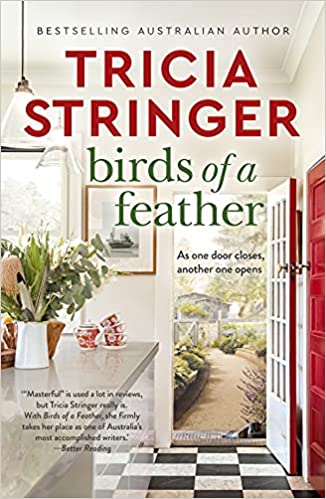
It’s good to branch out into a genre you don’t generally read much of, or an author not encountered before, and that’s what I’ve done with this contemporary fiction by Australian author Tricia Stringer.
Birds of a Feather is all about family and friendships, old and new. Set in fictional Wallaby Bay on South Australia’s Spencer Gulf, the story features three very different women. There is Eve, battling to maintain her independence after a crippling shoulder injury; her goddaughter Julia, struggling with suppressed grief and the sudden loss of her scientific research job; and Lucy, trying to be the best mother she can be to her two young children, and coping with the absence of her FIFO (Fly In Fly Out) husband.
The first part of the novel sets up the circumstances that bring these characters together: at first unwillingly, each feeling their way in a new situation, trying to overcome mistrust, hesitation and past hurts. Once the women are together, the story really gets going. Before that, there are hints and veiled references to their back stories, tensions, traumas and the circumstances that shaped each one, and it is fun to put their stories together as the novel goes along.
There are references to the Covid pandemic and the dilemmas faced by people like Lucy, an aged care worker, who must try to deal with an emotionally and physically draining experience while also worrying about her kids. It’s a very real scenario that brings home the additional challenges the pandemic introduced to already complicated lives.
The author captures the small town atmosphere beautifully: all the strengths of rural communities, along with the downsides that can accompany living in a place where everyone knows everybody else (and their business).
I found it soothing to be lost in the minutia of others’ lives, and the novel’s resolution was satisfying, even though some aspects felt a bit too tidy.
Birds of a Feather will be an enjoyable read for people who like to read character-based contemporary fiction about real-life struggles and challenges and the ways in which they can be overcome.
Birds of a Feather is published by HQ Fiction, an imprint of Harlequin Enterprises, in December 2021.
My thanks to the publishers for a review copy.Balm for the soul ‘A Hundred Thousand Welcomes’ by Mary Lee Donovan and Lian Cho

This gorgeous, gorgeous book is balm for the soul. The author says that This particular river of ink is my love song to our shared humanity and it is my protest against intolerance, injustice, and inhumanity. The creator of the beautiful, colourful illustrations says We fear what we do not know, and I hope that through these pages, readers will learn more about cultures and families and rituals different from their own.
These comments sum up what the book does: by presenting some of the many ways in which humans can express welcome and care for others, it shows us the things we have in common: food, families, friends, fun and language.
There are thirteen languages featured (along with helpful pronunciation guides) including Mandarin, Arabic, Hindi, Bengali, Urdu, and Lakota Sioux.
The double page spread at the end completes the book with a Gaelic blessing:
May you never know hunger
A Hundred Thousand Welcomes
May peace fill your nights
May your children’s children grow strong in the light.
May the road rise to meet you,
and walls fall away.
A hundred thousand welcomes
I sing,
I sign,
I pray.A Hundred Thousand Blessings is truly balm for the soul and belongs in every public and school library!
It is published by GreenWillow Books, an imprint of HarperCollins Children’s Books, in 2021.
My thanks to the publishers for a copy to review.Dust bowl and Depression: ‘The Four Winds’ by Kristin Hannah

I was in my twenties when I read John Steinbeck’s classic novel about the experiences of ‘Okies’, the derogatory name given to migrants from the US Great Plains states who, in their thousands, went west to California during the 1930’s. They did so in an attempt to escape the shocking dust storms, drought and poverty that ruined so many farms and livelihoods, hoping to find work picking Californian cotton and fruit. After reading The Four Winds, I am moved to want to re-read Steinbeck’s book, because there is so much human drama, endurance and tragedy in these stories.
The Four Winds begins in the Texas Panhandle, where Elsa Martinelli is an unloved and isolated young woman in a well-to-do business family. Her longing for love leads her to an encounter with Rafe Martinelli, son of Italian immigrants who have made Texas their home. Pregnancy follows, resulting in expulsion from her family, and Elsa marries Rafe and goes to live with the Martinelli family on their farm. She earns a place in the family and fully adopts the life of a farmer, wife and mother; she has finally found a home.
Then come the effects of years of drought: dead crops, heat and shocking dust storms that blight the land. Combined with the Depression, the result is that thousands of farmers and local businesses lose their ability to make a living and feed their families. After Rafe deserts them, and her son becomes seriously ill, Elsa makes the hard decision to join the throngs of desperate people travelling to California, lured by the promise of work in a ‘milk and honey’ land.
Of course, the reality is very different and if anything, the hardships and injustices faced by Elsa and her two young children are even worse than those they left behind.
The story takes in the efforts of unions and Communist party members fighting for workers’ rights, especially for the ‘Okies’ who face discrimination and abuse by big farming concerns. Elsa is a woman with little agency over her own life, but for the sake of her children’s future, she puts herself in the path of danger, great risk and tragedy.
The descriptions of the dust storms are truly terrifying, and the despair felt by those affected leaps from the pages. So does the independence and self-reliance of the American farmer at that time: proud to work the land and reluctant to accept government help of any kind. There is irony, too: the methods used by those farmers led to the degradation of the land which, when combined with drought, resulted in an ecological disaster that even then was seen as such by the federal government.
Elsa now knew how Tony had felt when his land had died. There was a deep and abiding shame that came with asking for handouts.
The Four Winds p280
Poverty was a soul-crushing thing. A cave that tightened around you, its pinprick of light closing a little more at the end of each desperate, unchanged day.The romance in the latter part of the novel did not work so well for me; overall though, The Four Winds brings to life a tragic period in American history and highlights the resilience and courage of the many people affected by the environmental and economic tragedies that played out in the 1930’s.
The Four Winds was published by MacMillan in 2021.

‘Australia Remembers: Len Waters, Boundless and Born to Fly’ by Catherine Baver

Len Waters was born behind the gates of an Aboriginal reserve, but his big imagination and even bigger dreams took him soaring beyond the reach of those who tried to confine him.
Len Waters: Boundless and Born to FlyLen Waters was a Kamilaroi man who became a trailblazer: probably only the second man of Aboriginal descent to be accepted into RAAF pilot training in the 1940’s, receiving his pilot’s wings in 1944 and graduating in the top four of his class – at just 19 years old.
Len went on to serve in the RAAF in the southwestern Pacific, flying bombing missions in his Kittyhawk aircraft Black Magic. Promoted to the rank of Flight Sergeant, he continued service in the Pacific until the war ended, when he’d been promoted to warrant officer.
Despite his bravery and skillful service, Len (and other First Nations servicemen and women) discovered that their service didn’t seem to matter once they returned to civilian life, and they faced the daily discrimination and disadvantage meted out to Aboriginal people in Australia.
This lovely book weaves Len’s childhood and early life experiences, the teachings of his parents and cultural knowledge, with his hard work, dreams and dedication, to create a picture of a truly remarkable Australian.
It is aimed at primary aged children and includes many illustrations and side boxes that pose questions for readers to consider as they learn more about Len and the Australia he grew up in and returned to.
It includes accessibly presented information on many key aspects of Australian First Nations culture and history: language, kinship, totems and respect for culture and knowledge holders, the British Empire and its consequences for First Nations people across the world, missions and reserves, Stolen Generations, Aboriginal servicemen in WWI, their experiences after that war and the Second World War.
I purchased the book for my 8-year old grandson who is interested in aircraft from this period, and also in stories about Indigenous Australians. I think it will well and truly tick both boxes.
Australia Remembers: Len Waters, Boundless and Born to Fly is published by Big Sky Publishing in 2021.


Sorrowful truths: ‘Bila Yarrudhanggalangdhuray’ by Anita Heiss

The first thing I love about this new novel by Wiradjuri author Anita Heiss is the title. Translating to ‘River of Dreams’ in English, it is in the Wiradjuri language, which is also sprinkled liberally throughout the narrative. What a privilege, to be given an opportunity to understand and experience words and phrases in the language of First Nations people.
The story starts with the drama and tragedy of the devastating 1852 Great Flood of the Marrambidya (Murrumbidgee River) in Gundagai, NSW. There are shocking losses of human and lives, property and livestock despite the heroic efforts of several men from the Aboriginal camp near the river, including Yarri, the father of the main character, Wagadhaany. She works for the Bailey family, a local White family. Yarri rescues his daughter and the two Bailey men who survived the flood, from their precarious perch on the roof of the house.
The river is a central theme of the novel, a presence both benevolent and destructive. It gives life and just as easily takes it away. The flood is important, as a real historical event that highlights the skill and courage of the Aboriginal rescuers, and also as a metaphor:
…as the canoe floats with effort to the shore, Yarri thinks about the two men there together; a naked White man and a barely clothed Black man are nothing but two men stuck in the middle of a devastating flood… A life is a life, he says over and over in his mind, knowing that the weather, the rain, the river don’t care what colour anyone is right now, and that in this moment they are equal. Yarri takes a deep breath and works his arms harder than he ever has, willing them both to bring both men to shore, and wishing they were both equals every day.
Bila Yarrudhanggalangdhuray p33Louisa is the other main character: a young Quaker woman who has been recently widowed in the flood, she meets and marries James, the eldest of the two surviving Baileys. Her Quaker beliefs lead her to wish for an equal relationship with the original people of the land, and she endeavours to achieve this with Wagadhaany.
So much gets in the way of a genuine friendship. Louisa is a good example of how well intentioned White people can still end up using relationships with First Nations people for their own purposes, while still desiring to act in a benevolent manner. The most obvious way that Louisa does this is to insist that Wagadhaany accompany the Baileys when they move to Wagga Wagga. Wagadhaany is devastated to lose connection with her mayagan, her family and the Country on which she was born and raised.
This allows the reader to try to understand something of the grief and loss experienced by First Nations people since colonisation:
How can she explain to Louisa, whose family chose to live on other people’s land, that she feels her sense of identity has been robbed, that everything that makes her Wagadhaany, the dancer, has been taken from her?
Bila Yarrudhanggalangdhuray p162Louisa is in many ways a sympathetic character, and in making her so, the author goes beyond the stomach-turning racism and cruelty perpetrated by Whites against First Nations people in this country, to explore some of the other ways in which racism manifests: the more subtle, systemic and insidious ways in which unequal power and racist assumptions play out.
Wagadhaany is an intelligent young woman, trying to assert her self and make sense of a world which has changed irrevocably for her people.
The irony is that, despite all her advantages and relative wealth, by the end of the novel Louisa is not necessarily the happier of the two women. Both characters face profound grief and loss. Wagadhaany’s connection to Country and kin help her to travel through these difficult events and by the end of the novel, there is space for hope.
Bila Yarrudhanggalangdhuray is a novel that uses real historic events to paint a picture of a colonial world which many Australians would prefer to either forget or romanticise. It’s a novel that made me think – always a good thing.
Bila Yarrudhanggalangdhuray was published by Simon & Schuster in 2021.


Magnificent (and flawed) men (and women) in their flying machines
‘Sundowner of the Skies’ : The Story of Oscar Garden, The Forgotten Aviator by Mary Garden

In the early morning of 16 October 1930, Oscar Garden set out from Croydon Aerodrome in South London in a second-hand, open-cockpit Gipsy Moth. On his feet he wore carpet slippers, and he had half a dozen sandwiches on his lap. His plan was to fly to Australia. He was 27 years old and had just learnt to fly, with a mere 39 flying hours under his belt.
Sundowner of the Skies p11This astonishing opening of Mary Garden’s biography and family memoir gives plenty of hints as to the story to come. The unlikely and dramatic adventure undertaken by her father when a young man, remains one of the great feats of early aviation, and Oscar Garden was also unusual in that he was one of the few early aviators who lived into old age.
Equally astonishing is the admission that he was more or less forgotten in the history of aviation, until quite recently, when his daughter Mary Garden wrote articles and then, this book about her father’s career and their troubled, unsettled family life.
The book, short-listed for the 2020 NSW Premier’s History Awards, gives readers insights into the romance and danger of those early years in aviation. We are now so accustomed to the criss-crossing of the skies by international and domestic airlines (at least until the Covid pandemic hit) that we can forget what a risky and uncomfortable business powered flight was in its early years. The exploits of those young aviators who broke records, took passengers up on joyflights, and piloted planes for the first commercial airlines, raised the public’s interest in flying and spurred the industry along.
Oscar Garden was one such, along with more famous names such as Charles Kingsford Smith, Amy Johnson, Bert Hinkler and Charles Lindbergh. There is now a portrait of Oscar in New Zealand’s Tauranga Airport, which was installed there in 2019. Before that, few would have known of Oscar Garden or his achievement.
According to his daughter, this was partly because, after a stint as a pilot for the forerunner of Air New Zealand, Oscar retired from the aviation industry and never flew a plane again, preferring to grow tomatoes in his adopted country, New Zealand.
There is much of interest in this book: the descriptions of the amazing exploits of early aviators (including a delightful reference to one woman who completed a long-haul solo flight in a skirt and pearls); the forced landings in dangerous circumstances; the fact that Oscar told no-one of his flight plan because he didn’t want to be talked out of it, and completed the whole thing on a shoe-string budget; the fact that early flights were navigated by a simple compass and what was known as ‘dead reckoning’. Amazing stuff.
For me, though, the most engrossing aspect of the story is the family history behind it. Oscar came from a wealthy Scottish merchant family, but family disputes and factions resulted in a troubled, restless, loner of a man who ended up suffering from mental ill-health and was unable to find any happiness in life. Mary’s recollections of her father and his relationships with others left her wondering ‘Who is this Oscar Garden?’ as she learnt more about his younger years.
It’s a poignant story of an emotionally frozen parent and a young adult trying to emerge from beneath his influence. The two Oscars – the adventurous youngster and the depressive older man and father – are woven together throughout the book, allowing the reader to experience some of the author’s confusion and ambiguity about the man who happened to be her father.
Sundowner of the Skies was published by New Holland Publishers in 2019.
My thanks to the author for a 2021 edition to read and review.